
Most coaches, consultants and speakers I talk to get almost every client the same way. Somebody they worked with a few years back mentions them at a dinner, and a warm email turns up a week later.
That feels great. It is also why so many of these businesses have revenue that looks like a roller coaster, and why the owner cannot answer a simple question: where are next quarter's clients coming from?
There are five real paths a client can take to you. Most people run one of them well and leave the other four almost completely empty. I want to put the whole map down and then take it apart piece by piece.
Quick context on why I am the one saying this. For the last five or six years I have run a content agency working with coaches, speakers and other business owners trying to get clients through social media. I have worked with hundreds of them, and I now own CreateSocial, which handles content production for exactly these people. So I spend most of my week looking at how businesses like yours actually get clients. What follows is the pattern I keep seeing, and the one I am applying myself.
Here is the video version if you would rather watch:
The Five Paths
This is the complete list. Every client you have ever signed came through one of these doors, and so will every client you sign next year.
- Referrals. Someone vouches for you before you ever speak. The highest trust you will ever get, and zero control over when it happens.
- Warm outreach. You reaching out to people who already know your name or your work.
- Content. Strangers getting to know you while you sleep. This one is the engine, and I will come back to it.
- Cold outreach. You reaching out to people who fit perfectly and have never heard of you.
- Paid traffic. Buying attention. The fastest feedback loop there is, and it costs real money.
What Most Expert Businesses Are Actually Running
This is not data. It is the pattern I see over and over when I look inside an expert services business.
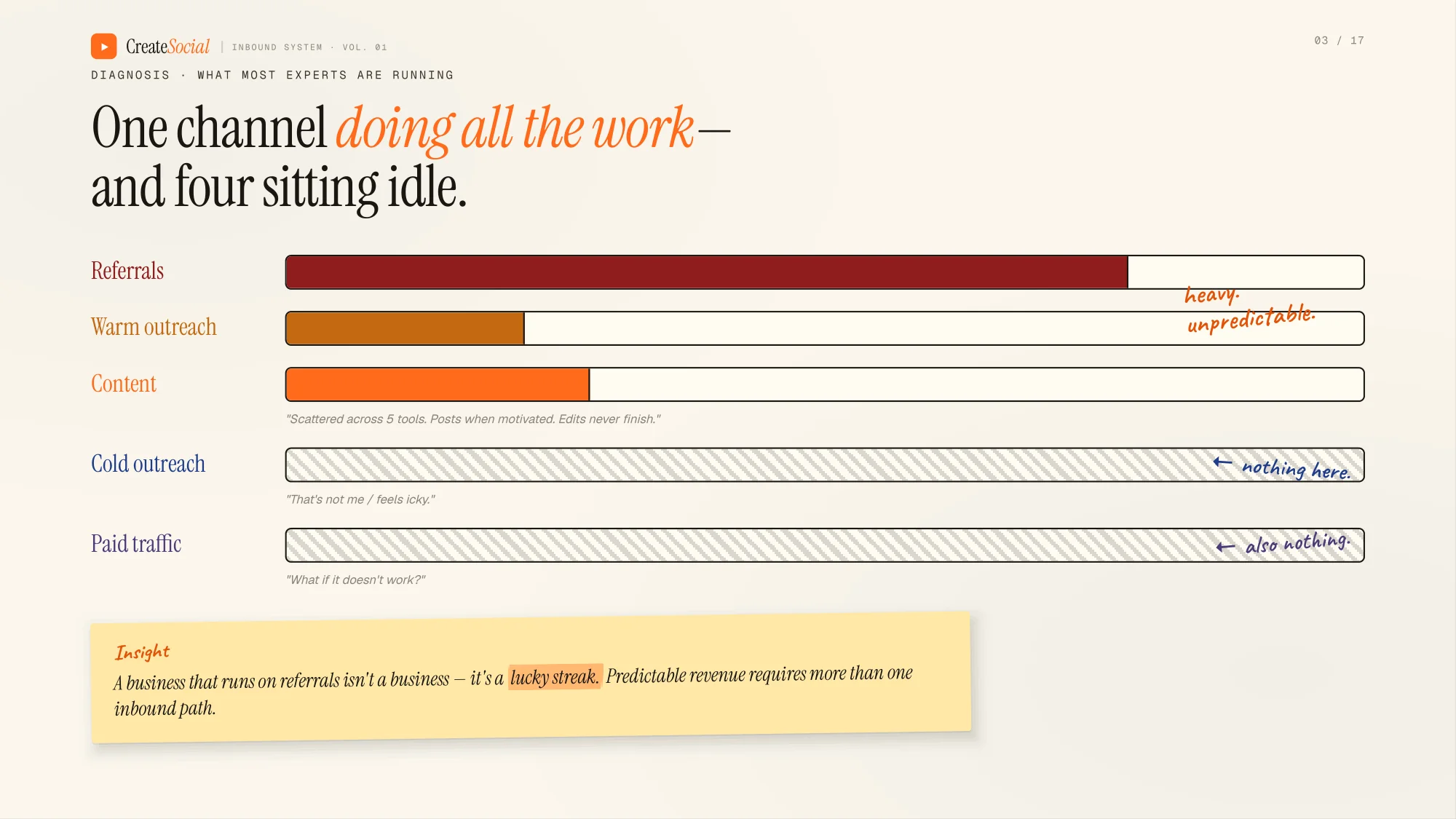
Referrals doing almost all of the work. Warm outreach a little, usually unstructured, usually a coffee chat that goes nowhere. Content inconsistent: you post when you are motivated, then go quiet for three weeks, with five tools open and nothing finished. Cold outreach, nothing. Paid, nothing.
Two entire paths sitting at zero, and nearly always for one of two reasons. Either it feels icky, or it feels risky.
So here is the uncomfortable part. A business that runs on referrals alone is not really a business. It is a lucky streak. It works right up until the quarter it does not, and when that quarter arrives you have no lever to pull. It scales exactly as far as your network does and not one client further. The moment you decide you want to grow past the size of the people who already know you, relying on referrals is the thing that stops you.
Four Ways to Judge a Channel
Before you go and fix the empty ones, you need to understand why the five are not interchangeable. There are four ways to judge a channel, and once you see all four at once you stop asking which channel is best, because the question stops making sense.
One thing I will say once for everything below. When I use numbers, treat them as illustrations of the shape, not forecasts for your business. Your rates will be your rates.
1. Lead quality
How ready to buy is somebody the moment they land in your inbox?
Referrals arrive pretty much pre-sold. Trust is borrowed before you say a word. Warm outreach has some prior signal behind it: a DM, a podcast, an intro. Content is people who have been consuming you quietly for months, sometimes years, and you have no idea they exist until they book. Cold outreach is the right person and the right offer with zero relationship. Paid is a stranger who glanced at you for six seconds.
Notice something about content specifically. It is the only path on this line that moves. Reach the right people and it slides up next to referrals. Reach merely a lot of people and it slides down next to paid. That difference is the whole subject of qualified attention, and it is why content can be your best channel or your most expensive hobby depending on who it reaches.
If lead quality were the only thing that mattered you would only do referrals. It is not.
2. Time per week
I mean ongoing hours out of your calendar once the thing is built, not setup time.
Paid traffic is about an hour. You set it, watch the numbers, tweak the creative. Cold outreach is roughly two hours once the infrastructure exists, because you are only replying to people who raised their hand and following up. Referrals about three: quarterly check-ins, client asks, partner nurture. Warm outreach around five, because it is personalized messages and real conversations. Content, fifteen hours or more. Filming, writing, editing, scheduling, posting.
That last number is the one that kills people. The channel with the worst leads costs you the least time, and the channel everybody tells you to do costs you the most. Whatever you choose, it is going to take time. Everything has a cost.
3. Predictability
If you put effort in this month, can you tell me roughly how many calls you will book?
Cold outreach is basically arithmetic. Five thousand emails, around fifty replies, around five calls. It is math, and a lot of the time it is predictable. Paid becomes a budget question as soon as your acquisition cost settles. Warm outreach is roughly forecastable: twenty DMs a week tends to surface one or two real conversations. Content compounds, but no single post is predictable, and you do not get to decide which one works. Referrals are pure weather. Great month, terrible month, and you did not choose either.
So the channel most people love is the one they can forecast the least, and that is exactly why your income feels lumpy.
4. Compounding
Will the same hour of work you do today still be paying you eighteen months from now?
Content is the only real compounder. A video you posted in 2024 is still bringing you leads in 2026. Referrals compound if you actually nurture them: each happy client unlocks two or three new conversations. Warm outreach builds a network slowly if you keep records. Cold outreach is brutally flat; every campaign starts at zero. Paid stops the hour you stop paying. Turn off the spend and the traffic dies that afternoon.
Cold pays you this month. Content pays you every month after that. You need both, and they are not substitutes for each other.
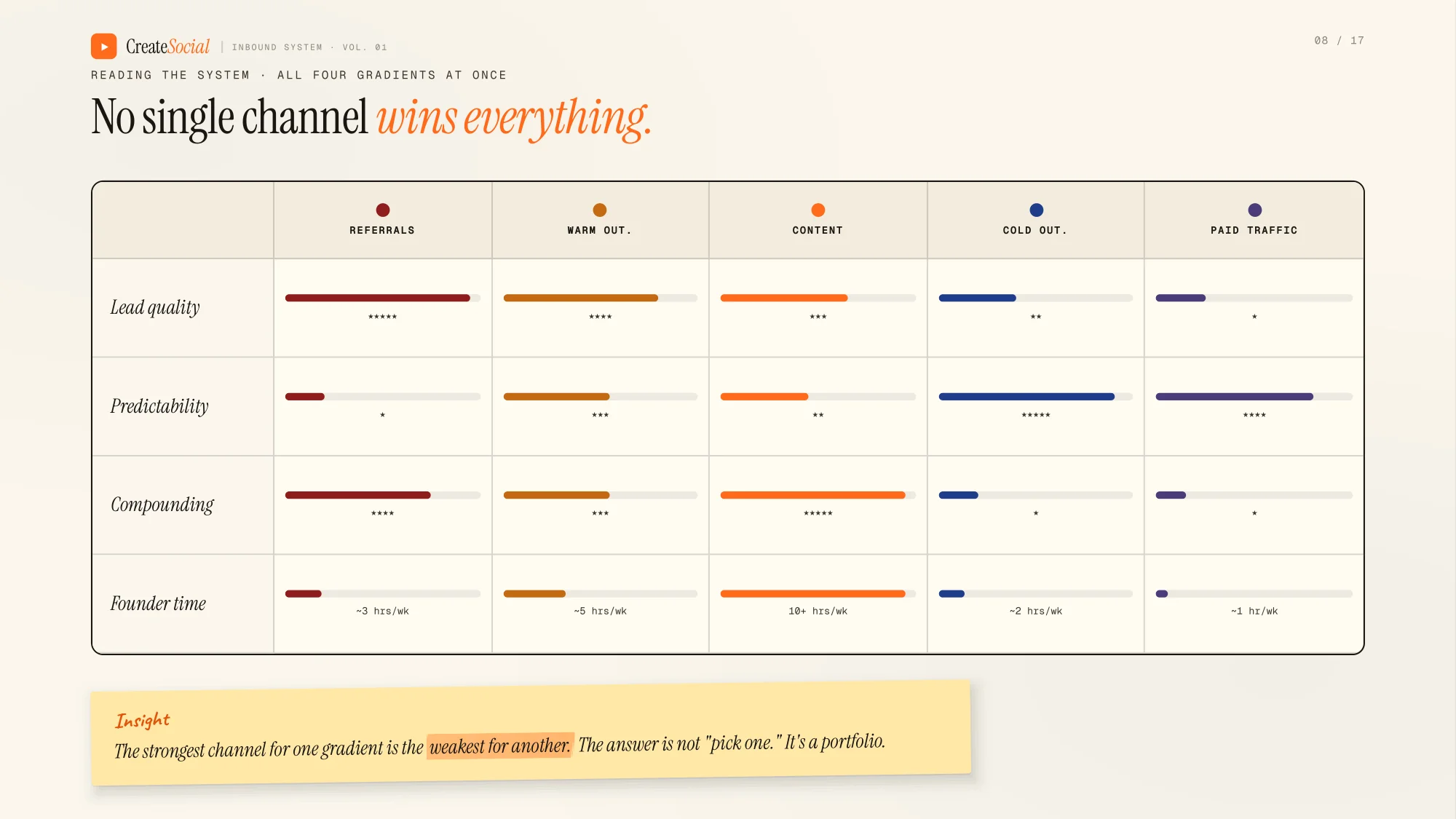
Put the four side by side and the answer falls out. There is no winner. Referrals win on lead quality and lose on predictability. Cold wins on predictability and loses on lead quality. Content wins on compounding and costs you your week. Whatever channel you are leaning on right now is strong on one axis and weak on another, and that weakness is exactly what you are feeling when the pipeline goes quiet and you do not know why.
So stop trying to pick a channel. Build a portfolio.
The Channels Feed Each Other
This is the part I do not see many people drawing together. These are not five separate pipelines. They feed each other.
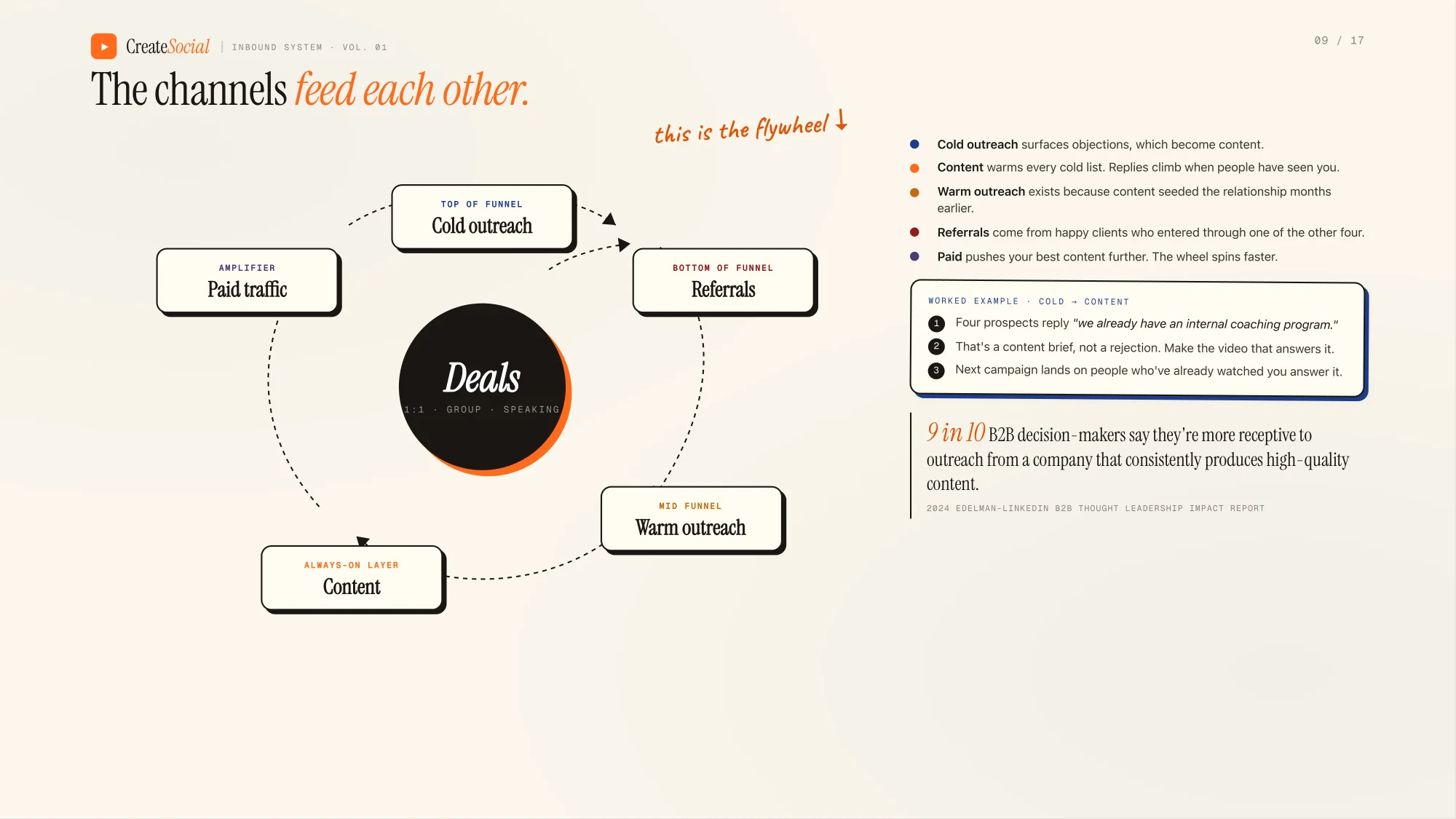
Cold outreach gives you conversations, and those conversations tell you exactly which objections to make content about. Say four prospects reply with "we already have an internal coaching program." That is not four rejections. That is a content brief. You make the video that answers it, and your next campaign lands on people who have already watched you answer their objection.
That content then warms your next cold list. Replies climb when somebody recognizes your name in their inbox. Warm outreach only works because content seeded the relationship months earlier. Referrals come from happy clients, and those clients almost always came in through one of the other four. Paid pushes your best content further, which spins the whole thing faster.
This is not just my observation. Edelman and LinkedIn surveyed B2B decision-makers and around nine in ten said they are more receptive to outreach from an organization that consistently produces good thought leadership.
So every channel you add makes the other four work better. Someone running three channels is not 50 percent ahead of someone running two. They might be several times ahead. I wrote the full version of this argument in content is the engine under every other channel.
Strategy is worthless without steps, so here is what each path looks like when it is run properly.
The Cold Outreach Playbook
This is the system I use for my own business. Four phases.
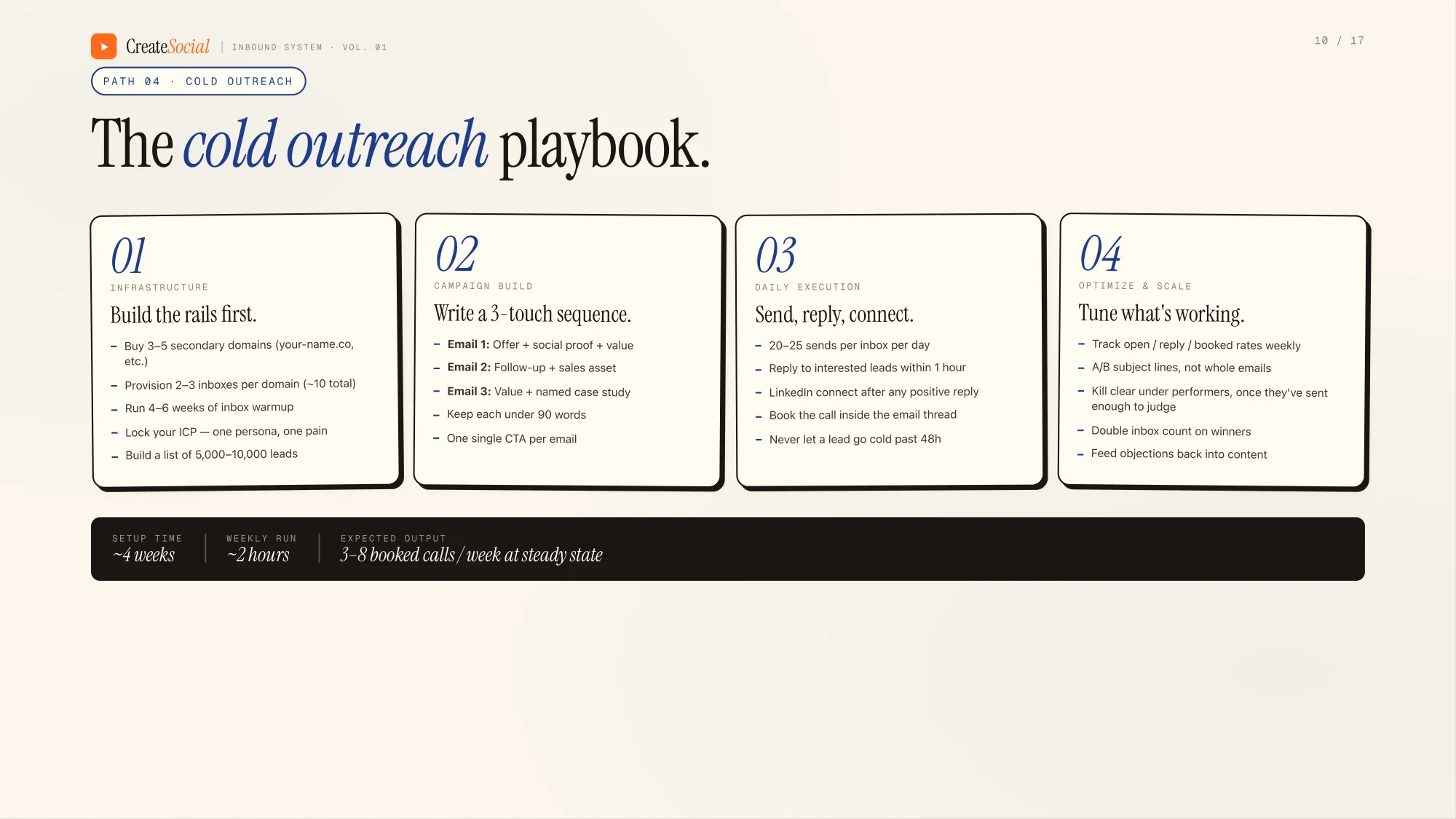
Phase one is infrastructure. Buy three to five secondary domains and never send from your main one. For me that looks like a team domain alongside the real one, never the real one itself. Two or three inboxes per domain, so about ten in total. Then warm every one of those inboxes up for four to six weeks before you send anything real. Warming up just means sending ordinary email from them so that when the real campaign starts, it actually lands in people's inboxes. Then lock your ICP: one persona, one pain. Start with a big list and get specific about title, company type, company size and location, because your interested reply rate goes up sharply the tighter that definition is. Build a list of five to ten thousand.
Phase two is the campaign. I recommend three emails. Email one is your offer, plus social proof, plus something genuinely useful. Email two follows up with a sales asset. Email three follows up with a named case study. Keep every one of them under ninety words, with one call to action and never two.
Phase three is daily execution. Twenty to twenty-five sends per inbox per day, and I would not send more. People blast, burn their domain, and end up hurting every campaign after. Reply to interested people within an hour if you can. Connect with them on LinkedIn the same day. Book the call inside the email thread rather than firing scheduling links into the void.
Phase four is optimizing. Track your reply rate, your interested reply rate and your booked rate every week. Test subject lines and different sales assets. Kill campaigns that are clearly underperforming against the others, but only once they have sent enough volume to judge. Do not kill a campaign after a hundred emails. When one is producing opportunities, double the inbox count behind it. And feed every objection you hear straight back into your content.
Roughly four weeks to set up, about two hours a week to run, and something like three to eight booked calls a week at steady state once the volume is up. Those are illustrations, not promises, and the more volume you push the more calls you book, depending entirely on how well you locked the ICP.
That is the one that pays you this month. Now the one that pays you forever.
The Content Playbook
One thing before the mechanics, because the mechanics do not save you if you get this wrong. Every piece of content has to answer one question: who is this for, specifically, and what problem do they have on the day they watch it? Not entrepreneurs. Not coaches. A person with a problem. If you cannot answer that, cadence does not matter. You will just be consistent at reaching the wrong people.
Once you can, a cadence that works is one long-form piece a week (YouTube or a podcast), three to five short-form videos, three to five written LinkedIn posts, one newsletter, and a blog post on your site. Batch the filming. Do not film daily. Filming daily is what breaks people, because you end up a full-time creator with a business on the side.
On platforms, LinkedIn and YouTube first. YouTube because the videos are longer, people invest more in them, and they are far more likely to be your actual buyer. LinkedIn because more of your target audience is active there than anywhere else. Short-form is worth it as a visibility engine because it is easy to get views. And do not neglect the newsletter, because it is the only audience you own.
Rotate four kinds of content rather than repeating one: authority, which is your point of view and your frameworks; proof, which is client wins and transformations; process, which is how you actually work; and personal, which is your own story. One of each a week is a good floor. Then repurpose, but be selective about it. I do not love chopping long-form into short-form unless the clip works with its own context. Video to written, or written to video, is the better trade: one long video becomes three LinkedIn posts, a carousel, a newsletter and a blog post.
Honest numbers on this one are hard. Setting up a good engine might take two weeks, probably more. Fifteen or more hours a week to run manually. And six to twelve months before it really starts paying you. That gap, between starting and seeing results, is where most people quit, and it is worth knowing before you go in. The full weekly plan is in a founder's weekly content plan.
The Relationship Playbooks
Warm outreach and referrals are the same place, and they run on the same input.
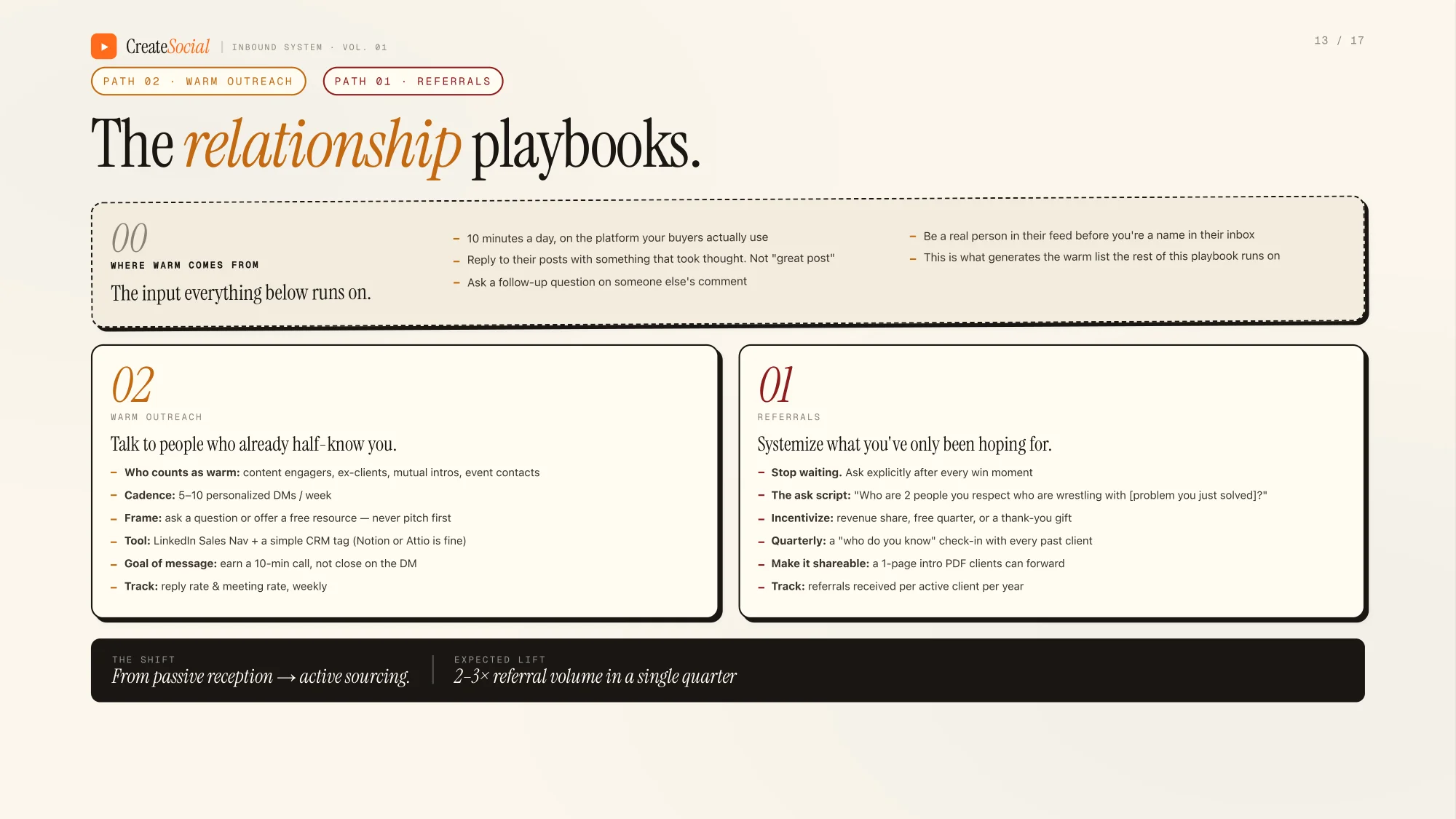
The input. Ten minutes a day on whichever platform your buyers actually use. Set a timer, go to LinkedIn, reply to people's posts with something that took real thought rather than "great post." Ask a follow-up question on someone else's comment. Be a real person in their feed before you are a name in their inbox. That ten minutes is what generates the warm list. Everything below runs on it.
Warm outreach. Warm means anyone who engaged with your comment, any ex-client, any mutual introduction, anyone you met at an event. Five to ten personalized messages a week. Ask a question or give something useful, and never pitch straight away in a message. The goal is a ten-minute call, not a close in the DM.
Referrals. These start happening when you start asking for them. Stop waiting. Ask at the moment of a win, not at the end of an engagement when someone is already moving on. The script can be simple: who are two people who respect you and are wrestling with the same thing we just fixed? Add an incentive if you like: a revenue share, a free quarter, a thank-you gift. Every quarter, go back through current and past clients with a "who do you know" message and give them a one-page intro they can forward. Most referrals die from friction, not from anyone being unwilling. People treat referrals as something that happens to them. Turn it into something you do on a schedule and you can get two or three times as many inside a quarter.
Paid Traffic: Principles, Not Tactics
I am going to stick to principles here rather than tactics, because paid is not my special zone and the tactics change every year.
Coaching and most high-ticket services are longer decisions. Pointing an ad at cold traffic with a booking page is asking for a big commitment off a cold impression. Ask for less. What tends to work is running to a free asset or a free tool, then building a small ladder behind it: something low-commitment after the opt-in, then something bigger, then the call. Each step earns the next one.
Watch cost per subscriber, cost per booked call, and cost per acquisition, and remember the booking can happen weeks later. If you judge purely on this week's bookings you will kill a campaign that was working. Give it enough budget for a readable sample and enough time to match your real sales cycle. If your cycle is ninety days, a thirty-day test tells you nothing.
And the smartest paid spend is usually not new creative at all. It is putting money behind organic content that is already working, and retargeting the people who already watched you, who are far more likely to buy. Paid is a volume knob on things that already work. Never point it at mediocre content.
The Honest Constraint
Most of those are manageable. Cold outreach is a couple of hours a week once it is built. Referrals are a quarterly habit. Warm is a few messages a week. Paid is a dashboard you check.
Content is fifteen or more hours every week, spread across five tools that do not talk to each other, and it is the one that breaks people over time. It is also the channel that makes every other channel work harder. So people start, go quiet after a month, and the entire flywheel stops.
The bottleneck is not strategy. You understood the strategy ten minutes ago. The bottleneck is production. Even I, having built the software and run the agency, have had stretches where I could not stay consistent. It is not that you do not know what to make. It is that you sit down to make one video and it eats your whole day, filming and editing and captioning and scheduling across five different tools. So you go hard for two weeks, then go quiet, and every time you go quiet it gets harder to come back.
Three Things to Take Away
- Stop running a single-channel business. Referrals are a reward for good work, not an acquisition strategy. Add at least two more active paths this quarter.
- Use cold outreach and paid as your forecasting tools. They convert lower, but they tell you what next month looks like. I see very few coaches ever running cold outreach specifically, and it is a big miss.
- Treat content as the compounder and solve the production problem, or accept that the flywheel keeps stalling.
The Bottom Line
Every client you will ever sign comes through one of five doors. Running one of them well is how most expert businesses work, and it is also why their revenue is a roller coaster and why nobody can say where next quarter is coming from.
Score the five on lead quality, time, predictability and compounding, and you will see there is no best one. Build the portfolio. Let the channels feed each other. And treat content as the engine underneath the rest, because it is the one that compounds, and the one that makes every other path convert better.
The production problem is the one I built CreateSocial to solve, because content only works as the engine if it does not become the thing you skip. Ideas come off a knowledge base built from your own material, so they sound like you rather than generic filler. You record with a teleprompter and in sections, so deciding what to say and saying it are separate jobs. And one click turns a recording into a blog post, LinkedIn post, newsletter, tweet or thread, with subtitles and captions for all six platforms done in the same place. The point is not the feature list. The point is that a month of content comes out of one sitting, which is the only way the system in this post survives contact with a real calendar.
If you want to see what this looks like for your business, drop your website in here and we will generate a short-form script, a YouTube outline and a LinkedIn post built on your actual expertise, free and without an account. Or start the free trial and run the whole thing.