

The short answer (updated November 2026):
- No, AI won't replace accountants. The Bureau of Labor Statistics projects accountant and auditor jobs to grow 5% from 2025 to 2035, and says AI "is not expected to reduce overall demand."
- It is replacing data entry. The same forecast has bookkeeping, accounting and auditing clerk jobs falling 6%, because software already does many of their tasks.
- Clients want more advice, not less. In Karbon's 2026 survey of 350 U.S. business owners, 81% said an accountant who lets AI handle routine work and spends the time on a monthly strategy call is worth more.
- I think the accountant AI replaces is the one clients only hear from in April. Answer the "should I" questions where people can watch, all year.
- Inside: 18 client questions a chatbot can't answer, sorted by season with a hook for each, and a screen-recorded script for a bookkeeper.
A client forwards you a chatbot's answer to their tax question with one line: "Is this right?" Mostly, it is. So what exactly are they paying you for?
AI won't replace accountants. It is replacing data entry, and the federal job forecast splits the field along that line: accountant jobs grow while clerk jobs shrink. What's left is advice, and clients say they want more of it. This page has the numbers, 18 client questions a chatbot can't answer, sorted by season and ready to film, and a full script for a bookkeeper.
Will AI replace accountants? The federal forecast says their jobs grow
No. The Bureau of Labor Statistics projects jobs for accountants and auditors to grow 5% from 2025 to 2035, faster than average, with about 115,300 openings a year.
The outlook names AI directly, alongside cloud computing and blockchain, and then answers the search in one line: "Although these technologies will likely increase accountants' efficiency, this change is not expected to reduce overall demand." Data entry goes, and the advisory and analytical side of the job becomes "more prominent."
One page over, the picture flips. The BLS projects bookkeeping, accounting and auditing clerk jobs to fall 6% over the same decade, about 85,600 fewer. "Software innovations have automated many of the tasks performed by bookkeeping, accounting, and auditing clerks," it says, so the same work "can be done with fewer employees."
So the forecast cuts the field in two. Jobs that judge the numbers grow. Jobs that only key them in shrink. The question worth asking is which side your week sits on.
AI is already doing the routine layer of the books
The routine layer goes first: data entry, categorizing transactions, reconciling accounts and first-draft reports.
Jung Ho Choi of Stanford's business school and Chloe Xie of MIT Sloan measured it in the field, with survey answers from 277 accountants and task-level data from 79 small and midsize firms. In Stanford's June 2025 write-up, accountants who use AI "support more clients per week and finalize monthly statements 7.5 days faster." They spend 8.5% less time on routine back-office processing and redirect it toward "business communication, quality assurance, and client-facing advisory work."
Practitioners describe the same shift. In Intuit's 2026 Accountant Technology Survey of 725 U.S. accounting professionals, 88% had used AI for at least one client service in the past year. The top uses were data entry and processing (54%), financial forecasting (51%) and real-time insights (49%). Only 6% want AI working on its own.
For a small firm, that changes the pitch. Fast, clean books used to be a selling point. When every firm in town runs the same software, they're the floor.
Bookkeepers who only enter data are the most exposed
Will AI replace bookkeepers? It is replacing after-the-fact data entry, because that's the task software does best. The bookkeeper who explains what the numbers mean is in a far stronger spot.
The BLS says as much. It expects clerks to "take on a more analytical and advisory role over the decade," and gives the example: "rather than entering data by hand, these workers may focus on analyzing their clients' books and pointing out potential areas for efficiency gains."
Think about what an owner gets from an app: categorized transactions, a dashboard, maybe a forecast. Nobody points out the software bill that doubled, the customer who always pays 60 days late, or the month cash will run thin. That noticing is the job now.
Clean books are what make the noticing possible. In Intuit's survey, manual data cleanup was "the top barrier to more proactive, higher-impact advisory work," named by 30%. Keep the books clean, then explain them, and you hold both ends of the work.
Is a CPA still worth it? The license carries what software can't
Yes, for anyone who wants to advise clients, because the license comes with accountability. A tool can draft a return. It can't sign it or answer for it.
Fewer people are lining up for that responsibility. The AICPA's 2025 Trends report counted 55,152 accounting graduates in the 2023-24 school year, down 6.6%. New CPA Exam candidates fell from 42,626 in 2023 to 28,082 in 2024, but read that drop with care. The AICPA notes that the year before a major exam change usually brings a surge, and 2023 was that year.
Students, the warning is real too. On r/CPA in September 2026, a new master's graduate asked whether "AI won't replace accountants, just get your CPA" is becoming cope. Entry-level routine work is what's shrinking, and Stanford's researchers found junior staff "more likely to accept AI-generated outputs at face value." Build the opposite habit. Question every output, and get good at telling an owner what their numbers mean.
Compliance is getting cheaper, and clients say advice is worth more
When software does most of a compliance job, its price falls, and the money moves toward advice. In the 2024 CAS Benchmark Survey from CPA.com and the AICPA, 206 client advisory services practices reported a median growth rate of 17%, and projected 99% median growth for their firms over the next three years.
Clients are asking for it. Karbon surveyed 350 U.S. business owners and leaders in July 2026. Trust was the top reason they chose an accountant, with 39% saying it matters most. Karbon's report page has the line to read twice: 81% say their accountant is more valuable if AI handles most of the routine work and the time saved goes into "a monthly strategy call."
Asked what AI can never replace, clients named their accountant's "judgment, knowledge of their business, accountability, and personal relationship." And CPA Practice Advisor's write-up of the report names the gap: "Clients rank proactive advice as the area they're least satisfied with."
Put those side by side. What clients want more of is what they get least. A chatbot can't fill that gap, because it doesn't know their business. You do.
Once software answers "what," clients call you about "should"
The questions left for an accountant start with "should." An app tells a client what they spent last quarter. A chatbot defines any tax term. Neither can weigh one business's cash, goals and risks, say what to do, and stand behind it.
| What software now answers | What clients still bring to you |
|---|---|
| What did I spend on subscriptions last year? | Which ones should I cut? |
| What was my profit last quarter? | Can I afford to pay myself more? |
| What will my cash look like next month? | Should I take the loan or wait? |
| Is this expense in the right category? | Is this customer worth keeping? |
| What does this tax term mean? | Does it change what I should do this year? |
The right column is your content plan. A chatbot answers each of those with "it depends." You know what it depends on, and saying so on camera is how a stranger sees you think before they ever book a call.
The accountant AI replaces is the one clients only hear from in April
A relationship that shows up once a year at tax time looks like a transaction, and software keeps getting better at transactions. A firm clients hear from in July and October looks like a partner. People shop a transaction on price every spring. They keep a partner. The Karbon numbers above say which one clients want.
Accountants are the second profession I name in If People Pay You for What You Know, Watch This. It opens: "If you are in a business where people hire you for what you know, I mean lawyers, accountants, doctors, authors, speakers, coaches, right now is the number one time to be building a personal brand because with AI coming, all this information out there is going to start to become commodified."
Tax explanations are already commodified. A chatbot can explain depreciation to anyone. It can't tell a contractor whether this is the year to buy the truck. That second answer is yours, and right now almost nobody outside your client list hears you give it.
Video lets a stranger hear it. A services page that lists "tax planning" never will. Long video goes further. Twenty minutes on why a profitable business keeps running short of cash lets an owner watch you work their exact problem. As I say at 11:24: "Then, if someone watches that, they're basically taking like a 20-minute coaching session from you right there."
Bankers get money questions they'd rather hand off, and a two-minute answer with your name on it is easy to forward. That's how content warms every other channel, referrals included. Financial advisors sell judgment to many of the same owners, and our companion piece on lawyers asks this question of the legal profession.
18 client questions AI can't answer for them, sorted by season
Small-business owners and self-employed clients bring these "should I" questions to accountants and bookkeepers. Each row has a hook and what a chatbot doesn't know, which is what your answer is really about. Tax season gets quick answers. The off-season is for bigger decisions and long videos.
Pick one kind of client before you film. A video for "small businesses" lands with nobody in particular. A video for restaurant owners in your county lands with people who could call you this week. I call this qualified attention.
Tax season: January to April
| # | The client's question | Hook for the video | What a chatbot doesn't know |
|---|---|---|---|
| 1 | Should I do my own return with software this year? | "Tax software or an accountant this year? Three questions decide it." | What changed this year: a new business, a move, a sale, a new baby |
| 2 | My refund is smaller than last year. Did I do something wrong? | "Smaller refund this year? What I'd check before you worry." | What changed in their pay, withholding and life since last April |
| 3 | Should I pay the balance now or set up a payment plan? | "Owe the IRS and can't pay it all today? How I'd think it through." | Their cash, other debts and what's coming in next month |
| 4 | I got a letter from the IRS. What do I do? | "Got a letter from the IRS? What I'd do the day it arrives." | What the letter actually says, and what's in their file |
| 5 | My side business made money last year. What changes now? | "Your side hustle made money. Here's what changes at tax time." | How big it is, where it's heading and what records exist |
| 6 | Should my spouse and I file jointly or separately? | "Married? Why I run the numbers both ways." | Both incomes, any debts and what each spouse owes |
| 7 | Should I put money into a retirement account before I file? | "Last-minute retirement contribution? Ask yourself this first." | Their cash, this year's income and what the money is for |
| 8 | Are my books good enough to file from? | "Before you send your books to your accountant, check these three things." | What's actually in their books, and what's missing |
Off-season: May to December
| # | The client's question | Hook for the video | What a chatbot doesn't know |
|---|---|---|---|
| 9 | Can I afford to add someone to payroll? | "Before you add anyone to payroll, run this math." | Months of cash on hand, how steady revenue is, what payroll really costs |
| 10 | Should I pay myself more, or leave the money in the business? | "How much should you pay yourself? The number I'd look at first." | What the business needs to keep, and what the owner needs to live on |
| 11 | Should I raise my prices? | "Busy all year and still short on cash? Look at your prices." | Margins by service or product, and which customers would stay |
| 12 | Is my biggest customer worth keeping? | "Your biggest customer might not be your most profitable one." | Hours spent on them, how late they pay and what they cost to serve |
| 13 | Should I buy equipment before December 31? | "Buying equipment to cut your tax bill? Do this math first." | Whether they need it, their cash and this year's income |
| 14 | Should I take the loan now or wait? | "Loan now or wait? What I'd look at in your books first." | Cash flow, what the money is for and how lumpy revenue is |
| 15 | We had our best month ever. Why is cash so tight? | "Best month ever and still sweating payroll? Here's where your cash went." | When money comes in against when it goes out, and work done but not billed |
| 16 | Should I switch accounting software? | "Thinking about switching accounting software? Check your process first." | How transactions really get recorded, and by whom |
| 17 | Can I just do my own books with an app? | "Doing your own books with an app? Here's what it won't catch." | How complex the business is, and what an hour of the owner's time is worth |
| 18 | I want to sell my business someday. Are my books ready? | "Planning to sell your business one day? Start with the books now." | How clean and consistent the books are, and how much depends on the owner |
Start with the five you hear most, in your clients' exact words. Questions 9, 15 and 18 also make strong long videos, because each splits into smaller questions. For when to post, our 12-month calendar for accountants maps the year to the IRS dates.
Your own files refill the bank. CreateSocial reads your website, your new-client FAQ, past newsletters and past videos, and turns them into video ideas with hooks and talking points. Choose "Ask me first" and it interviews you before it writes. The final question asks for something you've actually seen, like the cash crunch you've watched five clients walk into this year, told without a detail that points to any one of them.
A screen-recorded script for a hypothetical bookkeeper: where the cash went
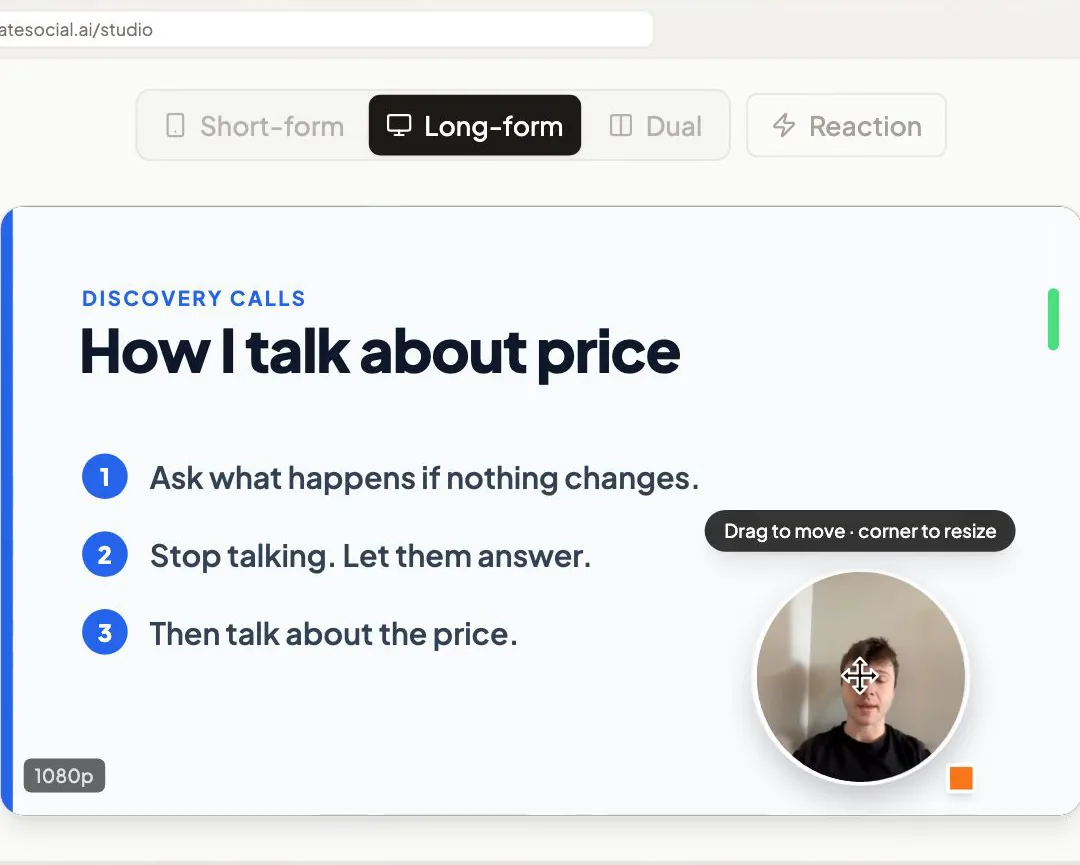
This is question 15, for a bookkeeper who works with trades and service businesses. It's a horizontal screen recording: you click through sample reports while your face sits in a corner bubble. Use invented numbers, so no client's books appear on screen.
Record it as six short parts, so a stumble costs one part. "A 3-minute video doesn't have to be one 3-minute performance. It could be six 30-second sections," as I say in my video on making content without becoming a full-time creator.
About 90 seconds, screen recording with a camera bubble
"Best month ever and still sweating payroll?"

PART 1 (screen: a title card with the question)
SAY: "Best month you've ever had, and you're
still sweating payroll? Your books aren't
lying to you. Your cash is just somewhere else."

PART 2 (screen: a sample profit and loss report)
SHOW: one month's net profit, invented numbers
SAY: "This is profit. It says the month made money.
It doesn't say when that money lands in the bank."

PART 3 (screen: a sample receivables aging report)
SHOW: unpaid invoices, sorted by how late they are
SAY: "First place cash hides: invoices you sent
that nobody has paid yet. If customers take
60 days, you're funding 60 days of their work."

PART 4 (screen: a list of finished, unbilled jobs)
SAY: "Second place: work you finished but haven't
invoiced. You've already paid the crew and
the materials. Nobody can pay you until it's billed."

PART 5 (screen: sample payments that aren't expenses)
SAY: "Third place: money that left without
showing up as an expense. The principal on
a loan. Equipment you bought. Owner draws."

PART 6 (screen: the three places, listed)
SAY: "Profit tells you the business works.
Cash tells you if you can make payroll Friday.
Check all three before you plan another big month.
Want a second pair of eyes on yours?
The link to book a call is on my profile."
It teaches one idea, and the viewer can check all three places in their own books tonight. The ask stays small, because someone who just learned something from you doesn't need a pitch.
In CreateSocial, share your screen and your camera rides in a bubble you can drag off the numbers and resize by its corner. A floating window stays on top of the reports with your record controls and your script points, the current one highlighted. Each part records as its own section with a one-tap retake.
Film the bank three ways: short answers, one long video a month and reactions
Film every question as a short answer first: 60 to 90 seconds, vertical, one question each, posted everywhere. That's how a stranger finds you.
Once a month, take a big question and walk through its parts. "Why profitable businesses run out of cash" becomes four: where the cash hides, how to spot it in your own books, how to close the gap and how to plan the next big month. That's the YouTube video an owner watches the week before they book a call.
Reactions answer the money advice already in people's feeds. Pick clips with the test from my video on reaction content: "Then ask yourself, if a client sent me this video, would I actually have something useful to say? If yes, record it. If no, just keep looking." A hook that works: "This tax tip is all over TikTok. Here's what it leaves out." How to make a reaction video covers the setup.
CreateSocial's reaction videos start from a pasted TikTok or Instagram Reel link, or a clip you upload, and you trim it to the claim. Layout keeps you and the clip on screen together. Stitch plays the clip first, then cuts to you.
Keep client details and refund or savings figures out of every hook, and check your state board of accountancy's advertising rules. If you practice before the IRS, section 10.30 of Circular 230 also bars misleading claims in any public communication about an IRS matter.
Batch the answers, then write from the best one
Thinking and recording are separate jobs, so give them separate days. I call this splitting thinking day from recording day. On thinking day, write three talking points per question. On recording day, go from one answer straight to the next without watching anything back.
Then write from what you recorded. I'd turn the best long video into a LinkedIn post or a carousel before I'd chop it into shorts. A carousel called "Three places your cash hides" is something a client saves and a banker forwards. CreateSocial writes those from the video in your voice, plus an email to your list. Schedule the month to TikTok, Instagram, YouTube, LinkedIn, Facebook and X, each with its own caption, and we post it for you once your accounts are connected.
Then give it time. Judge the bank after three to six months by the calls and referrals it brings in, not by a few weeks of views.
How CreateSocial turns your clients' questions into a year of content
CreateSocial helps you build a personal brand that brings in advisory clients, referral partners and speaking invitations, without content crowding out client work. It learns what you know and runs the whole content week, video and written: ideas, scripts, posts, recording, editing, thumbnails and scheduling. Each step of the bank has a feature behind it.
- Ideas from what clients already ask. Your knowledge base takes the website pages you pick, the documents you send clients, like a new-client FAQ, and your past videos. Out come 80 personalized ideas a month, each with a hook and talking points or a full script. Trending Now refreshes every Monday with what your niche is talking about, a good source of tax tips worth answering.
- Your answer, not a generic one. "Ask me first" interviews you before it writes. If a line still sounds like anyone's, fix it in the idea's chat or type over it.
- A season of answers in one sitting. Talking points sit on a teleprompter near your camera, the current one highlighted, and each answer is its own section with one-tap retakes, at your desk or in the iPhone app. Dual mode records 16:9 for YouTube and frames a 9:16 cut in the same take. Screen recording with your camera as a bubble handles walkthroughs like the cash script.
- Edits in minutes. Said the wrong figure? Delete the word in the transcript and the video cuts it. Remove Silences clears the pauses, eye contact correction keeps you looking at the viewer, and subtitles in 11 styles keep each answer readable on mute.
- Your webinar keeps working. Upload a recorded tax-season Q&A, and Find Clips suggests the moments that stand on their own, each turned into its own vertical video with subtitles.
- Writing and posting, handled. Turn any answer into a LinkedIn post, a list email or a LinkedIn carousel (PDF and PNG export), or start one from your knowledge base with no video. Schedule to six platforms with per-platform captions, and we post it for you once your accounts are connected. The Analytics page shows which answers got watched and shared on your connected TikTok, Instagram, YouTube, LinkedIn and Facebook accounts.
Also in the one plan: YouTube thumbnails made from your video and photos of you, reaction videos in Layout or Stitch, B-roll from free stock video, green screen and virtual backgrounds with or without a real green screen, safe-zone guides for vertical TikToks, Reels and Shorts, competitor tracking for the firms you follow, and X threads and blog posts of 1,500 words or more.
The accountant who picks up the phone in July keeps the client. I try to run CreateSocial the same way. I'm Ben Moore, and I built CreateSocial on my own, bootstrapped, here in Cincinnati, Ohio, so you talk to me directly. Feature requests come to me, and a lot of what customers ask for gets built. Before CreateSocial, my agency generated millions of followers and millions of dollars in revenue for its clients, and I've generated hundreds of millions of views.
It's $129 a month, or $99 a month billed annually, with no add-ons and no per-feature charges. Start your free trial and record the first five questions from the bank this week. Want help picking the questions that fit your clients? Book a free strategy call with me.
Start your question bank from this week's client emails
- Search your sent folder for five client questions that start with "should," "can I" or "is it worth."
- Match each to a row in the bank, or add a row.
- Write three talking points for each: what you'd check, what usually decides it and the next step.
- Record all five in one sitting.
- Post one a week. Send the strongest to the banker who refers you most, with a one-line note.
Repeat it monthly from whichever table fits the season. A free CreateSocial trial keeps the ideas, the talking points and the posting schedule in one place.
Questions people ask
Will AI replace accountants?
No. The Bureau of Labor Statistics projects jobs for accountants and auditors to grow 5% from 2025 to 2035, and says AI is not expected to reduce overall demand. It takes routine work like data entry, which makes advisory and analytical work a bigger part of the job.
What accounting jobs will be replaced by AI?
Tasks go before jobs: data entry, categorizing transactions, reconciling accounts and first drafts of reports. The roles built mostly on those tasks shrink most. The BLS projects bookkeeping, accounting and auditing clerk jobs to fall 6% from 2025 to 2035 because software has automated many of their tasks.
Will AI replace bookkeepers?
Software is taking over after-the-fact data entry, not the bookkeeper who explains the books. The BLS expects clerks to take on a more analytical and advisory role over the decade, analyzing clients' books instead of entering data by hand.
Are accountants being phased out?
No. The BLS projects about 115,300 openings for accountants and auditors each year, on average, from 2025 to 2035. The work is shifting toward advice and analysis as software takes the routine tasks.
Is a CPA still worth it in 2026?
For anyone who wants to advise clients, yes. The license carries the accountability clients say AI cannot replace, and fewer people are entering the field. The AICPA counted 55,152 accounting graduates in the 2023-24 school year, down 6.6%.
Is accounting still a good career with AI?
Yes, if you build toward judgment. Entry-level routine work is shrinking first, and Stanford and MIT researchers found junior accountants more likely to accept AI output at face value. The useful skills are questioning that output and telling an owner what their numbers mean in plain English.