
Most founders who are inconsistent with content do not have a discipline problem. They have a planning problem. There is no standing answer to "what am I making this week," so every week starts from zero, and starting from zero is exhausting enough that most weeks it does not start at all.
This is the plan. Not how to film it or how to batch it, which I have covered elsewhere, but what actually goes out, where it goes, in what mix, and what you turn into what. It is the content section of the five paths a client takes to you, expanded into something you can put on a wall.
Video version, if you prefer:
Before Any of the Mechanics
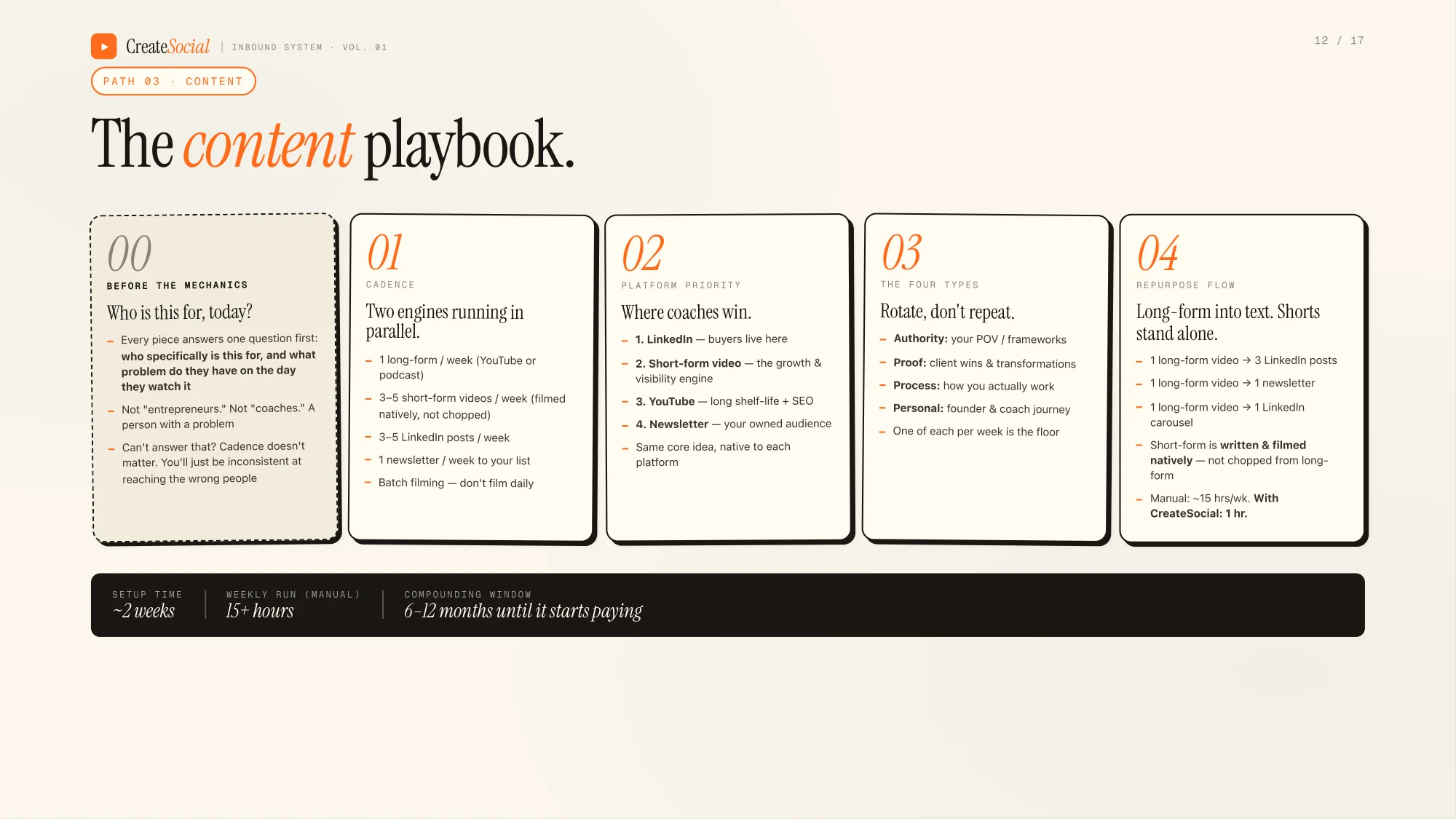
The plan does not save you if you get this part wrong. Every piece of content you make has to answer one question first: who is this for, specifically, and what problem do they have on the day they watch it?
Not entrepreneurs. Not coaches. A person, with a problem, on a particular day. If you cannot answer that for a piece of content, cadence does not matter. You will just be consistent at reaching the wrong people. I wrote the long version of this in qualified attention, and it is worth reading before you plan anything below.
The Cadence: Two Engines in Parallel
A cadence that works for a founder, coach or consultant looks like this, per week:
- One long-form piece. A YouTube video or a podcast episode.
- Three to five short-form videos. Filmed natively, not chopped out of the long one. More on that below.
- Three to five written LinkedIn posts.
- One newsletter to your list.
- One blog post on your own site.
Two engines running side by side: the long-form engine that compounds and gets found, and the short-form engine that gets seen. They do different jobs and you want both.
The one production rule I will state here, because it decides whether the cadence survives: batch the filming. Do not film daily. Filming daily is what breaks people, and it breaks the business too, because you end up a full-time creator with a company on the side. The mechanics of a batch session are in recording day shouldn't be thinking day and the one-afternoon version in social media for busy founders. This post is about what comes out of that session, not how to run it.
Where to Post
LinkedIn first. If you sell to businesses, more of your actual buyers are active there than anywhere else, and it rewards written posts and carousels, which are the cheapest formats on the list to produce.
YouTube second. The videos are longer, so people invest more in watching them, which makes a YouTube viewer far more likely to be your real target than someone who scrolled past a fifteen-second clip. And YouTube has a property nothing else does: your thinking becomes searchable and keeps working years later.
Short-form as the visibility engine. Instagram and TikTok are worth being on because it is genuinely easy to get views there. Treat them as reach, not as your buyer's home.
Do not neglect the newsletter. It is the only audience you actually own. Every other platform can change its algorithm or your reach tomorrow. Your list cannot be taken from you, and it is the one place you can push traffic on demand.
Same core idea, made native to each platform. That is the whole trick to being on four places without four times the work.
The Four Types: Rotate, Don't Repeat
The fastest way to run out of ideas is to only make one kind of content. The fastest way to sound like a content mill is to make the same kind every day. So rotate across four types, and treat one of each per week as the floor.
Authority. Your point of view and your frameworks. How leadership is being coached wrong. What the promotion conversation actually requires. The thing you believe that most of your peers do not. This is what makes someone think you have a specific way of seeing the problem rather than generic advice.
Proof. Client wins and transformations. What changed for somebody you worked with, told as a story with the principle drawn out. Names optional. This is the content that answers "does this actually work" without you having to say it.
Process. How you actually work. What the first session looks like. How you diagnose the problem. What you refuse to do. Prospects want a taste of what being your client is like, and process content gives them one for free.
Personal. Your own story. How you got here, what you got wrong, what you would tell yourself five years ago. People hire people, and this is the type that makes you one.
If you have read the six formats for executive coaches, notice these are types, not formats. A perspective piece is authority; a breakdown is process; a story-based lesson is proof or personal. The format is how you deliver it. The type is what job it does.
What to Repurpose (and What Not To)
Everyone says repurpose, so I want to be specific about it, because most of the advice is wrong for founders.
I do not love chopping long-form video into short-form video. It only works when the clip carries its own context, meaning somebody scrolling past could understand it without having watched the long version. Most clips cannot. They reference something said three minutes earlier and land as a fragment. So short-form should mostly be written and filmed natively, as its own idea, not carved out of the long one.
Video to written, on the other hand, is the best trade in content. One long-form video has several distinct premises in it, and each of those is a LinkedIn post. The whole argument is a newsletter. The framework in it is a carousel. The transcript, cleaned up, is a blog post. One recording becomes three LinkedIn posts, a carousel, a newsletter and a blog, all in your voice, and none of them is a chopped-up fragment of something else.
It runs the other way too. A written post that did well is a premise for a video. Written to video, video to written. That is the flow. Not video to video.
The Honest Timeline
Numbers on this are hard to estimate, and I want to be straight about them rather than sell you a fantasy.
Setting up a good short-form engine might take two weeks. Probably more, depending on how new you are to it. Running the full cadence manually is fifteen or more hours a week once you are actually filming, editing and writing. And it is six to twelve months before it really starts paying you, and that varies enormously at the start.
The gap between when you start and when you see results is where most people quit. Knowing that going in does not shorten the gap, but it does stop you reading the gap as failure.
A Week's Output, Laid Out
Put it all together and a working week of content looks like this going out:
- One long-form video, with a specific person and problem behind it.
- Three to five short-form videos, each its own idea, one of each of the four types across the week.
- Three to five LinkedIn posts, most of them pulled from the long-form video's premises.
- One newsletter, which is that video's argument in prose.
- One blog post, which is its transcript made readable.
That is one recording session's worth of raw material spread across six outputs. The plan is the same every week. What changes is the idea.
The Bottom Line
You do not need to be more disciplined. You need a standing answer to "what am I making," so that the week never starts from zero. One long, three to five short, three to five written, a newsletter, a blog. LinkedIn and YouTube first. Rotate authority, proof, process and personal. Turn video into writing, not into more video.
The fifteen hours is the part that makes this plan hard to keep, and it is the part CreateSocial is built to collapse. Ideas come from a knowledge base built on your own material, you record with a teleprompter in sections, and one click turns a recording into the LinkedIn posts, newsletter, blog post and threads above, with subtitles and captions for all six platforms in the same place. There is a free trial if you want to run this plan without it becoming a second job.
And if you want to understand why this plan matters more than any single channel, content is the engine under every other client channel is the argument for it.