

The short answer (updated November 2026):
- Marketing agencies get clients through five paths: referrals, warm outreach, content, cold outreach and paid ads. Without ads, run the first four on purpose instead of waiting for the next referral.
- Referrals are agencies' top-rated source, scoring 3.7 out of 5 in a 2026 survey of 91 agency leaders. Ask for introductions on a schedule and add two referral partners.
- Pick a niche you can name in one line, so you can list every prospect and speak their language.
- Open outreach with a question about their business, never a pitch. Get anyone interested on a 15-minute call within a day.
- Put the owner on camera, talking to buyers. Only 41% of agency leaders work on their own social content, so the bar is low.
A good run of referrals ends, the calendar goes quiet, and you start wondering where next quarter's clients will come from.
A marketing agency gets clients through five paths: referrals, warm outreach, content, cold outreach and paid ads. If you don't want to run ads, work the first four on purpose, for one niche, with the owner on camera. Here are the steps, an outreach message pair to copy, and a first month filled in for a three-person agency that serves dentists.
How to get clients for a marketing agency in seven steps
- Name one niche in one line: who you serve, where, and the result. "Independent general dentists in Colorado" is a niche. "Small businesses" is not.
- Ask every happy client for one introduction, on a schedule, and set up two referral partners who serve the same businesses you do.
- Message 20 owners a week who fit your niche. Open with a question about their business and leave the pitch out.
- Record a month of content in one sitting, with the owner on camera answering the questions buyers ask.
- Make the decision pieces buyers look for: how you work, what it costs, who you are not for and what the first 90 days look like.
- Get anyone who shows interest on a 15-minute call within a day.
- Count calls by path every Friday, and turn each objection you hear into next month's content.
None of these steps needs an ad budget. They need a few hours every week, busy weeks included. Run them only when work is slow and your pipeline will feel like weather.
Agency lead generation runs on five paths, and referrals are only one
Of the five paths, referrals are the one agency leaders rate highest. In a 2026 survey, Promethean Research asked 91 agency leaders to rate 34 tactics from 1 to 5 on how much of their revenue comes from each. Client referrals scored 3.7, growing current accounts 3.6 and partner referrals 3.0. No other tactic scored above 3.0.
So keep your referrals, but don't run the agency on them. You never pick the month a client happens to mention you. As I argue in my video on the five client channels, a business that runs on referrals alone is on a lucky streak. Streaks end.
| Path | What it looks like for a small agency | When it pays |
|---|---|---|
| Referrals | A happy client or a partner mentions you to someone | Whenever it happens. You don't choose the month. |
| Warm outreach | Messaging people who know you or engage with your posts | This month |
| Content | The owner's own videos and posts, made for one niche | It warms every other path now, then pays every month after |
| Cold outreach | Question-first messages to niche owners who don't know you yet | This month, once the volume is up |
| Paid ads | Ads behind posts that already start conversations | As soon as you pay, and it stops when you stop |
The paths feed each other. A video gives a cold message something to point to, and a "not right now" tells you what to post next. The five paths a client takes to you scores each path, and content is the engine under every other channel explains why content makes the other four work harder.
Pick a niche you can name in one line
A niche you can name is one you can list, study and talk to. Most agencies already claim one. A 2026 Promethean survey of 1,452 agency leaders found that 86% call themselves specialists: 77% by service and 55% by industry.
Industry is the kind that helps most. Industry specialists reported lower sales complexity than service specialists, scored as months to close times meetings needed. "We do paid social" gives a prospect nothing to recognize. "We run video for independent dentists" tells a dentist this is about them.
Fill in this line first:
We help ________ (who, by industry and size)
in ________ (where, if it matters)
get ________ (the result they would pay for).
A niche you can name also has a list you can count. The ADA's Health Policy Institute counts 205,088 professionally active dentists in the US as of 2025, about 60 for every 100,000 people. A metro area of a million people holds roughly 600 of them. At 20 messages a week, one person works through that list in about seven months.
Social media agencies find this hardest, because social fits every business. An SMMA that serves everyone sounds like every other SMMA. If dentists are your niche, our marketing playbook for dentists lists what a practice should post, which doubles as your service menu.
Agencies sell content, and fewer than half make their own
Agencies make content all day for clients and very little for themselves. In Promethean's survey, only 41% of agency leaders put effort into social media content for their own agency. Overall it scored 2.0 out of 5 for revenue, but where deals close quickly, leaders rated it 3.3.
My read: the gap is about who the content is for. Most agency content goes out under the logo and talks shop with other marketers, so the likes come from other agencies. The practice owner scrolling at 9 p.m. never sees it. Content pays an agency when it reaches the owner who signs.
So put the owner on camera. A buyer hires a small agency for its people, and the owner is the person they will talk to first. As I say in my Instagram strategy video, "Skip the big guru in your niche and go find the buyer." For an agency, the guru is every marketing influencer you're tempted to comment under. The buyer is the practice owner.
Answer the questions practice owners ask you, in short videos, and add one or two longer YouTube breakdowns a month. They get fewer views than a viral tip. More of those viewers can hire you. That trade is what I call qualified attention.
Where this stalls is the blank page in week three. CreateSocial builds 80 personalized ideas a month from your knowledge base: your website, case studies and past videos and posts. "Ask me first" asks a few questions before it writes, so each video carries a pattern from your own client work.
Decision content answers the questions buyers ask before a call
Decision content is what a buyer watches right before they reach out. It answers what people feel awkward asking a stranger: what it costs, how long it takes, what you need from them. Save those for the sales call and some buyers will pick the agency that answered.
Buyers need trust before they pay. In my video on getting coaching clients I put it this way: "People aren't just going to randomly decide that they want to pay you $2,000 on a random Tuesday when they've never really seen you or heard of you too much and never had a real conversation with you." Decision content is that conversation, before they ever talk to you.
Six decision pieces for an agency:
- How we work, from the first call to the first monthly report.
- What it costs, in ranges, and what moves the price up or down.
- What we need from you each month, in hours.
- Who we are not a fit for, said plainly.
- What the first 90 days look like, including the slow part.
- The three numbers we report every month, and why those three.
Make each one once, as a short video and a written post, and pin them where buyers look: your LinkedIn Featured section, your services page and the email you send before a call. The content funnel shows where decision pieces sit after discovery and depth content.
Show proof without breaking client confidentiality
Proof is the hard part for an agency, because your best results belong to clients who never agreed to be shown. You still have more than a wall of logos.
- Share patterns, not clients. "Across our practices, the videos that answer the cost question start the most calls" names no one. Say it only if it is true for you.
- Ask up front. Add a line to your contract asking whether you may share results, and ask again after a good quarter, when yes is easy.
- Let the client approve the case study before it goes anywhere, with only the numbers they are happy to show.
- Walk through your reporting template filled with sample data. Prospects see how you think, and nothing private is on screen.
- Make your own account the case study. Your posts and the calls they start need nobody's permission.
Then be careful what you promise. Promise what you control: the videos, the posting schedule and the monthly report. Buyers who have been burned by a big guarantee notice the agency that promises the work instead.
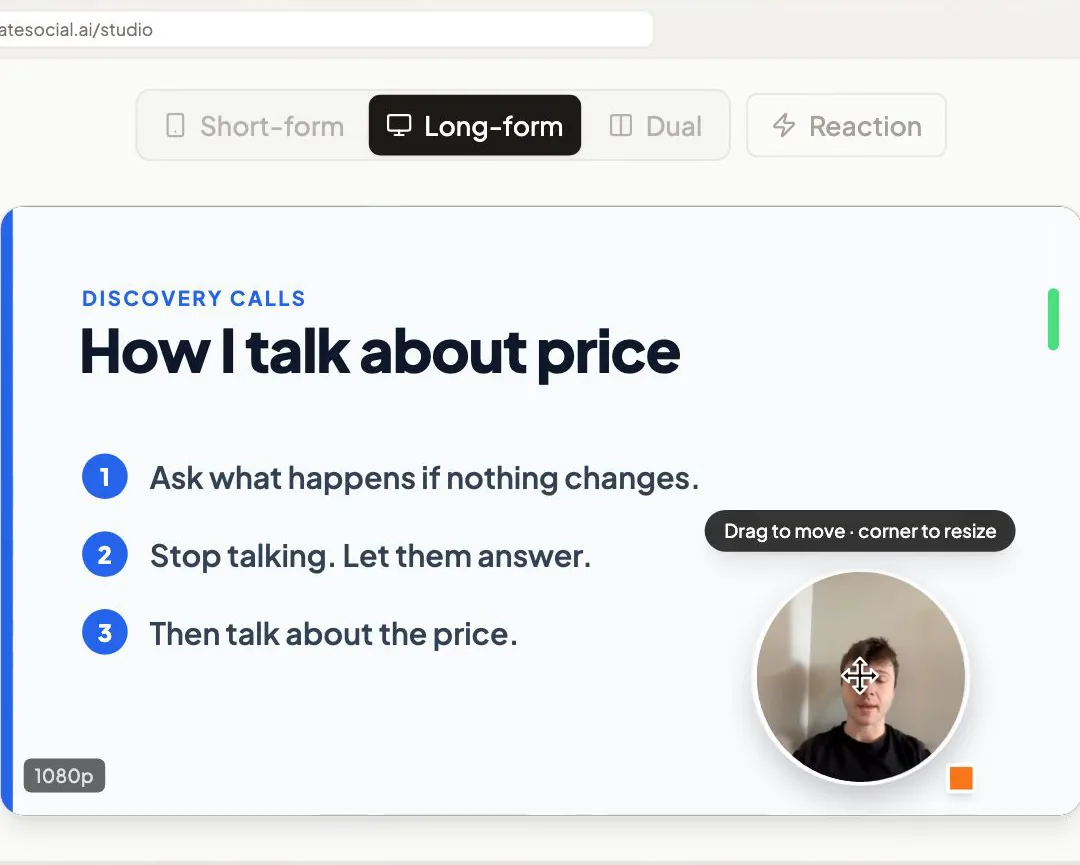
For the walkthrough, CreateSocial records your screen with your camera as a bubble you can drag anywhere and resize, so you talk through a sample report with your face in the corner.
Open outreach with a question, never a pitch
Outreach works when the first message is about them. A pitch asks a stranger for a decision. A question asks for an opinion, and people like giving those. In the Instagram strategy video I say cold DMs still work and people ruin them by pitching straight away. LinkedIn and email are no different.
Read their website, Google profile and last few posts first. Then copy this pair and fill the brackets:
MESSAGE 1 (LinkedIn or email)

Hi Dr. [last name], quick question about [practice name].
When a new patient calls for the first time, what do they
ask about first: cost, insurance or whether it will hurt?
I run a small team that makes videos for dentists in
[state], and I'm trying to learn which question comes up most.

MESSAGE 2 (when they answer)

Thanks, that helps. [One specific thing you've
noticed about that question, in a sentence.]
Would 15 minutes this week help? I'll show you how
I'd answer it on video for [practice name].
Thursday at 12:30 or Friday at 8:00?
Message 1 asks one thing a busy owner can answer in ten seconds. Message 2 gives something back before it asks for the call, and two set times take one word to accept.
If they say not right now, reply: "No problem. Can I send you the video when we make it?" Then make it. In the five channels video I call a rejection like that a content brief. It tells you exactly what to post next.
Get interested people on a 15-minute call fast
Speed decides who gets the call. A 2011 Harvard Business Review study of 1.25 million sales leads found that firms that tried to contact a lead within an hour of the query were nearly seven times as likely to have a meaningful conversation with a decision maker as firms that tried an hour later. A reply to your outreach is a lead in the same race.
So when an owner answers, reply the same day and offer the call inside the thread. Skip the intake form. An owner who has watched your videos and answered your question has told you most of what a form would ask.
Aim for more calls than you need. As I say in the coaching clients video, "You want so many calls and so many relationships being created that you have to start qualifying people and turning people away." Fifteen minutes is short enough to say yes to and long enough to learn whether they fit.
Spend the call on their situation: what they have tried and who else decides. Show one thing you would do for them, and end with one next step and a date. How to get coaching clients walks the same path from a video to a booked call.
Referral partners send clients you would never reach alone
A referral partner serves the same businesses you do but sells something else. In Promethean's survey, leaders rated partner referrals 3.0, behind only client referrals and growing current accounts. Yet only 53% put effort into them.
For a dental agency, good partners are dental CPAs, brokers who help dentists buy and sell practices, practice management consultants, dental IT and phone providers, and web designers who don't do social. Send them this:
Hi [name], I see a lot of your clients are independent
dental practices. Mine are too. We run their video and social.
What's the marketing question your clients ask you most,
the one you'd rather hand to someone? Happy to send
practices your way when they need [their service], too.
Then ask clients on a schedule, not once a year. After a good month, send this:
Glad the [result they're happy with] is working.
Who's one other practice owner you'd trust me to talk to?
I'll only reach out with your OK, and I'll say you sent me.
Give partners something back: send referrals their way, and make a short video answering a question their clients ask. A partner can forward a video more easily than describe you.
A first month for a three-person agency that serves dentists
This agency is hypothetical: an owner, an account lead and a content producer. Client work keeps all three busy, so its own marketing runs mostly on the owner's time: one recording session a month and about two hours of outreach a week. Its line reads: "We run video and social media for independent general dentists in Colorado, so new patients have already seen the dentist before they call."
| Week | Owner | Account lead and producer | Count on Friday |
|---|---|---|---|
| 1 | Puts the line on LinkedIn and the homepage. Records the month in one session: 12 short answers, two long breakdowns and a "how we work" video. | Account lead asks each current client for one introduction and builds a list of 100 practices in two counties. Producer turns the long videos into LinkedIn posts and a carousel, and schedules three posts a week. | Introductions asked and made |
| 2 | Sends message 1 to 20 practice owners. Replies the same day to anyone who answers. Pins the "how we work" video to LinkedIn Featured. | Account lead sends the partner message to a dental CPA, a practice broker and a dental IT company. | Replies and calls booked |
| 3 | Sends 20 more. Takes every call within a day. Records a short "what it costs" video, because the calls keep asking. | Account lead holds two partner calls and asks the happiest client for a written OK on a case study. Producer logs every objection the owner hears on calls. | Calls held and proposals sent |
| 4 | Follows up with everyone from weeks 2 and 3 who went quiet. Drafts the case study for the client to approve. Plans session two from the objection log. | Account lead sends a partner a referral the other way. Producer totals the month by path. | New clients and calls by path. Keep what booked calls. |
Six of session one's short answers, written as practice owners ask them:
- "Do I have to be on camera, or can my hygienist do it?"
- "How long before social media brings in a new patient?"
- "What should the front desk say when someone calls about a video?"
- "Is TikTok worth it for a dental practice?"
- "How much chair time does a month of filming take?"
- "Why does my Google profile get views but no calls?"
The two long breakdowns go to YouTube: "What a new patient sees when they look up a dentist in your town" and "How we would plan a practice's first 90 days of video."
The recording session is the step CreateSocial is built for. Your talking points sit on the teleprompter near your lens with the current point highlighted, and each answer is its own section with one-tap retakes. A stumble costs one answer, not the whole session.
In month one, most calls come from introductions, partners and outreach, and the videos help each of those land. In my speaking gigs video I say to give content three to six months before you judge it, and an agency's own content is no different.
How CreateSocial runs your agency's own content
CreateSocial helps you build a personal brand that brings in clients, speaking gigs and customers, without content taking over your week. For an agency owner, that means the agency finally markets itself while your team's hours stay on paying clients. It learns what you know and runs the whole content week, video and written: ideas, scripts, posts, recording, editing, thumbnails and scheduling.
- Your niche's questions arrive every month. Add your website, case studies, past videos and sales-call notes to your knowledge base, and CreateSocial turns them into 80 personalized ideas a month, each with a hook and talking points or a full script. "Ask me first" asks about a real client moment before it writes. Trending Now adds what your niche is talking about every Monday, and competitor tracking brings in new posts from the agencies you follow.
- One session records the month. Read talking points from the teleprompter at your desk or on the iPhone app, in sections with one-tap retakes. Dual mode frames 16:9 and 9:16 at once, so one take covers YouTube and LinkedIn as well as Reels and Shorts.
- The edit doesn't need your editor. Cut the video by deleting words from its transcript, and Remove Silences takes out the pauses in one click. Eye contact correction, subtitles in 11 styles and B-roll from your own files or free stock video finish it.
- Every video becomes a week of written posts. Turn one answer into a LinkedIn post, an X thread, an email to your list, a blog post or a LinkedIn carousel you export as a PDF or PNG. On weeks you skip the camera, it writes them from your knowledge base with no video at all.
- It goes out on time, and you see what worked. Schedule to TikTok, Instagram, YouTube, LinkedIn, Facebook and X with a caption written for each platform, and we post it for you once your accounts are connected. The Analytics page tracks views, likes and shares on your connected TikTok, Instagram, YouTube, LinkedIn and Facebook accounts, and "Make another like it" turns a winner into your next idea.
Also in the one plan: YouTube thumbnails made from your video and photos of you, Find Clips to pull standalone clips with subtitles from a recorded webinar or talk, screen recording with your camera as a bubble, reaction videos in Layout or Stitch mode, green screen and virtual backgrounds with or without a real green screen, and platform safe-zone guides.
You run a small shop, so you know what it means when the owner answers. I'm Ben Moore, and I built CreateSocial on my own, bootstrapped, here in Cincinnati, Ohio, so you talk to me directly. Feature requests come to me, and a lot of what customers ask for gets built. Before CreateSocial, my agency generated millions of followers and millions of dollars in revenue for its clients, and I've generated hundreds of millions of views.
It's $129 a month, or $99 a month billed annually, with no add-ons and no per-feature charges. Start your free trial and record your first session of niche questions this week. Want to work out your niche line and your first ten questions together first? Book a free strategy call with me.
Send five questions and book one call this week
- Write your niche line and put it on LinkedIn and your homepage.
- Ask two happy clients for one introduction each.
- Send message 1 from the pair above to five owners in your niche.
- List ten questions prospects asked you this quarter, in their words.
- Record your answers in one sitting. A free CreateSocial trial gives you the teleprompter and sections for it.
Then answer every reply the same day, and offer the call.
Questions people ask
How do marketing agencies get clients?
Mostly through referrals. In a 2026 Promethean Research survey of 91 agency leaders, client referrals scored 3.7 out of 5 for revenue, the highest of 34 tactics. To grow steadily, add referral partners, question-first outreach and the owner's own videos.
How do I get my first client as a marketing agency?
Start with people who already know you. Tell former colleagues and past employers the one type of business you now serve, and ask who they know that fits. Then message owners in that niche with a question, and offer a short call once they answer.
How do I get clients for my SMMA?
Pick one industry so every message and video speaks to one kind of owner. Open outreach with a question instead of a pitch, and post short videos of yourself answering the questions those owners ask. Offer a 15-minute call as soon as someone shows interest.
How do social media managers get clients?
Most start with referrals from past employers and clients. The steady flow comes from a niche you can name, your own account as the portfolio, and question-first messages to owners in that niche.