

The short answer (updated November 2026):
- Marketing for dentists works when the patient you want hears you answer their question before they book. Short videos of your chair-side answers do that.
- Market one treatment at a time. Twenty implant candidates in your town beat 20,000 views from people who will never sit in your chair.
- Make the video most practices skip: the one the front desk texts to a patient who left with a treatment plan.
- Lead with the platform each treatment's patients use. In Pew's 2026 survey, 85% of adults aged 50 to 64 used YouTube, and 79% of adults under 30 used Instagram.
- Film the month in one afternoon, then spend about 90 minutes a week across the team. Count calls and accepted plans every Friday.
Your hygiene schedule is full. The implant, aligner and veneer consults aren't, and last month's treatment plans are still sitting on kitchen tables.
Marketing for dentists comes down to one move: let the patient you want hear you answer their question before they decide. Short videos built from chair-side questions do that, and the best one goes home in a text after the consult. Here are hooks for six treatments, two scripts, the text that sends a video home with a treatment plan, a team routine and a filled-in month.
Market one treatment at a time, to the patient who wants it
Pick the treatment you want more of, then picture the one patient who wants it. Make every video for that person.
Many of the dental idea lists Google surfaces lean on fun facts, giveaways and holiday posts. Those collect likes from people who will never book. I call the alternative qualified attention: aim at the people who could become patients, not at the most people. Twenty implant candidates in your town beat 20,000 strangers.
The ADA's guide to building a marketing plan gives you the test. Track patient inquiries and actual new patients side by side. "When marketing is working well, there is very little gap between these two totals." A video made for one patient keeps that gap small.
Write one line per treatment: who it's for, the moment the problem shows up, the treatment and your town. For implants: "I help people whose partial slides when they eat get implants in [town], without guessing at the cost." Each line is a content pillar, as in content pillars for coaches, so rotate them month to month.
Patients look you up before they book, so let them hear you first
Before a new patient calls, they look you up. A friend's tip, an ad and a Google search all end with someone reading your reviews and deciding whether to trust you with their mouth. As I put it in my speaking-gigs video, "before anyone actually books you, they're going to search you."
That's why content is the engine under every other channel. Of the five paths a patient takes to you (referrals, warm outreach, content, cold outreach and paid), content feeds the other four, and it outlasts them. An ad stops when the budget does. A video filmed this month still answers questions next spring.
Nervous patients need this most. Someone who has avoided the dentist for six years isn't comparing prices. They want to know if you'll be kind, and a minute of your voice tells them.
So put a cut where people check first. Google Business Profile Help allows videos up to 30 seconds long, so a 30-second cut of each video belongs on your listing, beside your reviews.
Lead with the platform your patients use for that treatment
Choose platforms by treatment, not by what other dentists post. Pew Research Center's 2026 survey of 5,511 U.S. adults shows wide gaps by age, and each treatment tends to draw an age group. That pairing is our read, not Pew's.
| Treatment you want more of | Lead with | Share of the likeliest age group using each platform | Source |
|---|---|---|---|
| Implants, dentures and full-mouth work | Facebook and YouTube | Ages 50 to 64: YouTube 85%, Facebook 71%. Ages 65 and over: YouTube 65%, Facebook 59% | Pew, 2026 |
| Whitening, bonding and aligners for young adults | Instagram, TikTok and YouTube | Ages 18 to 29: YouTube 95%, Instagram 79%, TikTok 65% | Pew, 2026 |
| Veneers, adult aligners and new families | Instagram, Facebook and YouTube | Ages 30 to 49: YouTube 91%, Facebook 78%, Instagram 64% | Pew, 2026 |
Checked against Pew's fact sheet, published October 19, 2026, on November 2, 2026.
Lead with the platform for the treatment you want most, then post every video on the rest. YouTube is in every row, so make it your library: a full implant consult video can keep getting found for years.
Your best posts are the questions patients ask in the chair
Patients ask the same few questions while you're holding the mirror. "Will it hurt?" "How long does an implant last?" "Why does insurance cover this but not that?" Each one is a video. The ADA's guide already counts "chair-side conversations to promote cosmetic dentistry" as marketing time, and a video holds that conversation for everyone who searches. Have the front desk and hygienists write the questions down all month, in patients' own words.
Sort them into the four kinds of post I use in the weekly plan for founders. Authority posts explain a worry. Process posts walk through a visit and answer the fear that keeps people from booking. Personal posts say why you added implants, or why you still see kids on Saturdays.
Proof comes easiest to a dentist, because you have the smile. Before a patient's smile, face or story appears anywhere, get their signed permission, as federal privacy rules require for marketing, and run before-and-after photos past your state dental board's advertising rules. A pattern across many patients counts as proof too, and it names nobody.
"Your content should make your buyer feel seen before it makes you look smart," as I say in my video on why followers don't bring clients. You want to explain the anatomy. The patient wants to know whether it hurts and what it costs.
Hooks for six treatments, from first look to the final yes
Every treatment needs a video that finds the patient and one that answers their last question. Discovery, depth and decision are the three stages I lay out in my video on building a buyer pool, and most people stop at discovery. How a content funnel turns views into clients covers all three.
| Treatment | Discovery hook (finds the patient) | Decision hook (answers the last question) |
|---|---|---|
| Implants | "If your partial slides when you eat, watch this before your next adjustment." | "What happens at an implant consult here, minute by minute." |
| Clear aligners | "Adults ask me if they're too old for aligners. Here's my answer." | "What's included in the price of aligners at our office, and what isn't." |
| Whitening | "Strips, trays or in the office? How I'd whiten for a wedding three months out." | "How long whitening lasts, and how to make it last longer." |
| Veneers | "Five questions to ask any dentist before you get veneers." | "Your veneer consult, from the first photos to the preview of your new smile." |
| New families | "When should your child first see a dentist? Here's what we tell parents." | "Your toddler's first visit here, from the waiting room to the sticker." |
| Nervous patients | "If you've put off the dentist for years because you're embarrassed, this one's for you." | "Everything you can ask us to do differently if you're nervous." |
Borrow what already works. Look on YouTube for dentists whose videos far outrun their subscriber count, then make your version. Or react: play a viral at-home whitening hack and say what you'd tell a patient. Reaction videos for coaches breaks the format down, and 60 video hook examples has more openers.
A script for the patient who's been avoiding you
Each video is a hook, three points and an ask, filmed one section at a time. This discovery video runs about 30 seconds:
HOOK
If you've put off the dentist for years because
you're embarrassed about what we'll find,
this one's for you.

POINT 1
You're not the first person to tell me that,
and you won't be the last.

POINT 2
Your first visit here starts with a conversation.
We talk before you sit in the chair, and you
decide what happens that day.

POINT 3
If you want to stop at any point, raise your
hand. We stop.

ASK
Call [number] and tell the front desk you saw
this video. They'll book you [extra time].
At 30 seconds it fits your Google listing whole. Put it there first, then pin it on each social profile.
Send a video home with every treatment plan
The patient who leaves with a treatment plan is the one most marketing forgets. They've seen the scan and heard the price. Then they decide at the kitchen table, with nobody to answer the next question. As I say in the buyer-pool video, "The content doesn't need to perform. It doesn't need tons of views. It needs to exist because the buyer who is 80% of the way there is going to be looking for it." A patient holding your plan is that buyer.
So film a decision video for each treatment you plan often. This one for implants runs about a minute:
HOOK
Thinking about an implant? Here's exactly what
happens at the consult, so nothing surprises you.

POINT 1
We start with what bothers you now: chewing,
the way it looks, a partial that moves.
You talk. I listen.

POINT 2
Then we take [a scan and photos]. I show you
what I see on the screen, in plain English.

POINT 3
You leave with a written plan: each step, how
long it takes, and what it costs with and
without insurance. You don't decide that day.

ASK
If you've been putting this off, book a consult
at the link in my profile. Bring every question.
Embed it on your implant page. Then, within a week, the front desk texts it to every patient with an open implant plan:
Hi [name], it was good to see you on [day].
Here's the video Dr. [name] mentioned. It walks
through each step of the plan we talked about:
[link]

Any question at all, call or text [number].
[Your name], [Practice]
If plans that got the video are accepted more often, film one for your next treatment. The Friday count below tracks it, and our video script template has more examples.
The front desk is where a video becomes a patient
A video brings a patient only when every step after it works. The five links from a Reel to a booked call run from the video to your profile, a post that asks, the conversation and the consult. In a dental office, the front desk owns the last two.
That's where practices lose people. A caller says "I saw your video about implants," lands on hold, and the moment passes. Give the front desk one line: "Great, which one did you see? Let's get you in with the doctor." The ADA warns that "even the best marketing campaign can fail if your practice's internal systems can't support it." For a video, the system is whoever answers the phone.
After a good visit, hand patients a video to forward
Happy patients send your warmest new patients, and a video makes the referral easy. A patient whose sister dreads the dentist will forward your nervous-patient video in seconds. After a good visit, the front desk sends this:
Thanks for coming in today, [name].

If anyone you know has asked about [aligners],
this two-minute video answers the first question
most people have: [link]

We'd be glad to see them. [Practice], [phone]
Ask for a review the same way every time, and offer nothing for it. The review and the 30-second clip then sit side by side on Google.
A monthly email to your patient list keeps you in mind between cleanings, even for patients who never open Instagram. CreateSocial writes that email, and a blog post for your treatment page, from what you said on camera, in your voice. You check the clinical details and send.
Film the month in one afternoon, then spend 90 minutes a week
Plan on one day and film on another. Recording day shouldn't be thinking day splits content into four jobs: decide, say, record and edit. Do all four at once and anyone sounds stiff.
So decide first. Once a month, choose 12 questions from the team's list and write a hook and three talking points for each. That's about an hour, and CreateSocial shortens it. Add your website and treatment brochures to its knowledge base, and it suggests the month's ideas with hooks and talking points ready.
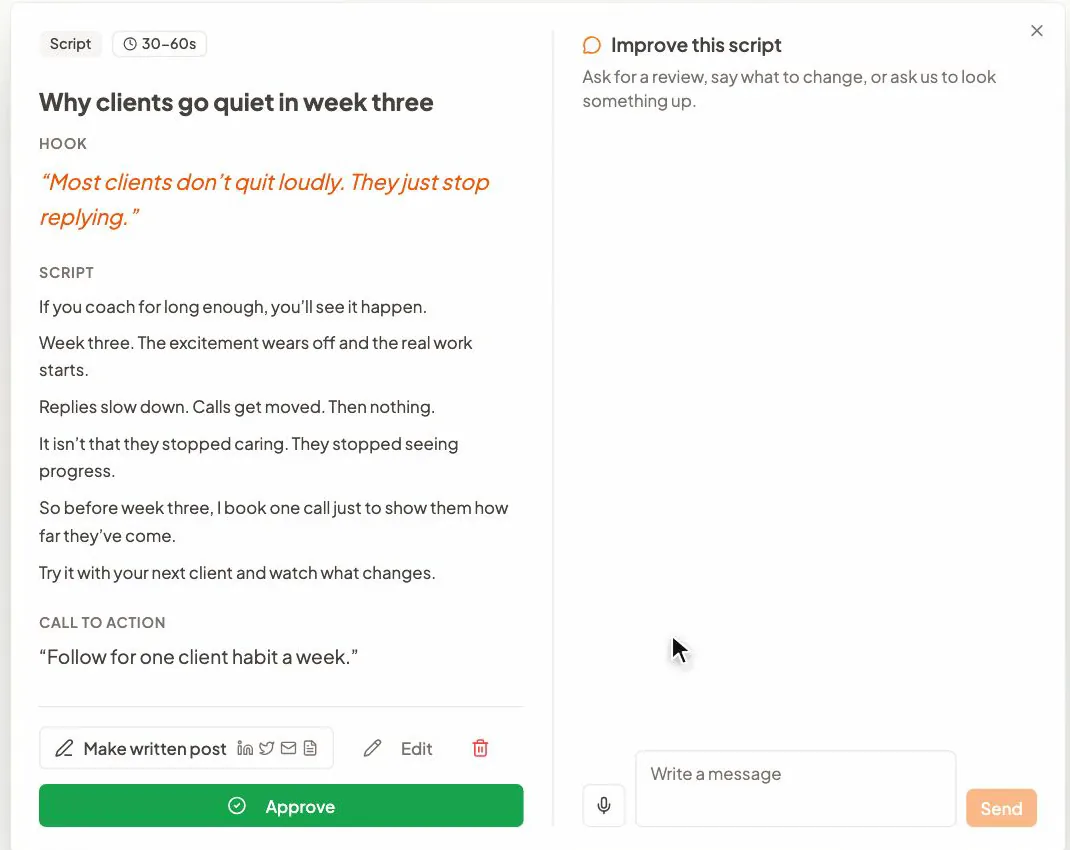
Then film all 12 after the last patient, the way my one-afternoon batching plan for busy founders lays out. "Your goal isn't to build a beautiful studio. Your goal is to make recording boring," as I say in my video on content that never becomes a second job. The operatory will do. In CreateSocial the teleprompter holds your three points right by the lens, and a flubbed section is one tap to redo, at your desk or on the iPhone app.
| When | Job | Who | Time |
|---|---|---|---|
| Last week of the month | Pick 12 chair-side questions. Write a hook and three points for each. | You | 1 hour |
| First week of the month | Film all 12 in sections, then edit, write the posts and schedule the month. | You, plus one team member | 3 to 4 hours |
| Every weekday | Write down new patient questions. Reply to comments and messages. | Front desk and hygienists | 10 minutes |
| Wednesday | Text the decision video to patients with an open treatment plan. | Front desk | 15 minutes |
| Thursday | Send the forward-this note and a review request after good visits. | Front desk | 15 minutes |
| Friday | The count. | You and the office manager | 15 minutes |
That's about 90 minutes a week across the team. For scale, the ADA's guide expects the office manager of a practice that markets in-house to spend "about 25% of his or her time (about 10 hours per week)" on it. This plan covers the content part.
Count calls and accepted plans every Friday
Ask "How did you hear about us?" on every new-patient call, so Friday has real answers. Then fill this in:
FRIDAY COUNT, WEEK OF ______

New-patient calls ___    Consults booked ___

What did they call about?
  Implants ___   Aligners ___   Whitening or veneers ___
  Kids and families ___   Other ___

How did they hear about us?
  A patient sent them ___
  Google search or Maps ___
  A video (which one?) ________
  An ad ___   Insurance list ___   Other ___

Treatment plans presented ___   accepted ___
Plans that got the video text ___   accepted ___

Patient question to film next month: ________
The last line is next month's first video. If a video brings calls for treatments you don't offer, change its hook.
Then give it time. Your first month is the thinnest your library will ever be, and I tell people to give a content plan three to six months before judging it.
A filled-in month for a hypothetical general and cosmetic practice
Picture a two-dentist practice that wants more implant and aligner cases and more young families. Its profile line: "Implants, aligners and family dentistry in [town], explained by the dentists who do them."
Open the 12-video month
| Week | Video | Kind of post | Its job | First stop |
|---|---|---|---|---|
| 1 | "If your partial slides when you eat, watch this before your next adjustment." | Authority | Finds implant patients | Facebook and Shorts |
| 1 | "If you've put off the dentist for years because you're embarrassed, this one's for you." | Process | Gets the nervous patient to call | Every profile and the Google listing |
| 1 | "Why we started placing implants in this office." | Personal | Builds trust | Facebook and Instagram |
| 2 | "Adults ask me if they're too old for aligners. Here's my answer." | Authority | Finds aligner patients | Instagram and TikTok |
| 2 | "What happens at an implant consult here, minute by minute." | Process | Answers the last question | YouTube, the implant page, every open implant plan |
| 2 | "Your toddler's first visit here, from the waiting room to the sticker." | Process | Answers parents' last question | Facebook and Instagram |
| 3 | "A dentist reacts to a viral at-home whitening hack." | Authority (reaction) | Finds whitening patients | TikTok and Instagram |
| 3 | "What's included in the price of aligners at our office, and what isn't." | Process | Answers the last question | YouTube, the aligner page, every open aligner plan |
| 3 | "Three things almost every adult says before starting aligners." | Proof | Builds trust | Instagram and Facebook |
| 4 | "Implant, bridge or partial? How I walk patients through the choice." | Authority, 8 minutes | Builds trust | YouTube, plus a blog post for the implant page |
| 4 | "Does dental insurance cover implants? The honest answer takes 60 seconds." | Authority | Finds implant patients | Facebook and Shorts |
| 4 | "Five questions to ask any dentist before you get veneers." | Authority | Finds veneer patients | Instagram, plus a LinkedIn carousel of the five |
Every third video ends with "Book a consult at the link in my profile," and the monthly patient email carries the implant consult video. Marketing for chiropractors builds a month for a spine clinic, and marketing for accountants plans a whole year around IRS deadlines.
Let CreateSocial run the month while you see patients
CreateSocial helps dentists build a personal brand in their town that brings in the patients they want, plus referrals and invitations to speak, without giving up the hours between patients. Feed it what you know and it runs the content month, video and written: ideas, scripts, posts, recording, editing, thumbnails and scheduling.
- Your treatment pages become the idea list. Scan your website, pick the implant, aligner and family pages, and add your brochures to the knowledge base. Then 80 personalized ideas a month arrive with hooks, plus talking points or a full script for each. "Ask me first" asks what you've seen in the chair before it writes.
- The operatory becomes your studio. The teleprompter is right by your lens and highlights the point you're on, at your desk or on the iPhone app. Each answer is its own section with a one-tap retake. Dual mode films 16:9 for YouTube and marks the 9:16 frame for Reels.
- The edit works like a document. Delete a word in the transcript and it's cut. Remove Silences clears the pauses, eye contact correction keeps your gaze on the viewer, and subtitles in 11 styles reach people watching on mute.
- One answer feeds the written side: a blog post for your implant page, an email to your patients, a LinkedIn post, an X thread or a LinkedIn carousel exported as a PDF, in your voice. No video that week? They come from your knowledge base.
- Find Clips suggests the moments in the 8-minute implant video, or a patient seminar you recorded, that stand on their own, and turns each into a vertical clip with subtitles.
- Schedule the month to TikTok, Instagram, YouTube, LinkedIn, Facebook and X, each with its own caption, and we post it for you once your accounts are connected. The Analytics page lines up followers, views, likes, comments and shares from your connected TikTok, Instagram, YouTube, LinkedIn and Facebook accounts with Friday's count.
Also in the one plan: YouTube thumbnails built from your own video and photos, competitor tracking for dentists elsewhere whose videos you admire, Trending Now's Monday list of what your niche is talking about, reaction videos in Layout or Stitch mode, screen recording with your camera in a bubble for walking through a treatment diagram, virtual backgrounds whether or not you own a green screen, free stock video for B-roll, and safe-zone guides for Reels, Shorts and TikTok.
Your patients like knowing who's behind the mask, and so will you. I'm Ben Moore, and I built CreateSocial on my own, bootstrapped, here in Cincinnati, Ohio, so you talk to me directly. Feature requests come to me, and a lot of what customers ask for gets built. Before CreateSocial, my agency generated millions of followers and millions of dollars in revenue for its clients, and I've generated hundreds of millions of views.
The plan is $129 a month, or $99 a month billed annually, with no add-ons or per-feature charges. Start your free trial and have your first treatment-plan video ready by Friday. If you'd rather choose your first treatments with someone, book a free strategy call with me.
Send your first treatment-plan video this week
- Pick the treatment you plan most often and write its line.
- Ask the front desk for every patient who left with that plan in the last 60 days and hasn't booked.
- Film the decision video in sections. The teleprompter and sections come with a free CreateSocial trial.
- Text it to that list with the note above, and put a 30-second cut on your Google Business Profile.
- Add "Which video did you see?" to the front desk's new-patient call.
Next Friday, look at one line on the count: plans that got the video, and how many said yes.
Questions people ask
What are some effective marketing ideas for dentists?
Answer the question patients ask most about a treatment you want more of, in a video of about a minute. Put a 30-second cut on your Google Business Profile, text the full version to patients deciding on a treatment plan, and give happy patients the link to forward.
How much does dental marketing cost?
Agency retainers vary widely, so compare written quotes. Running marketing in-house costs mostly staff time, and the ADA estimates about 10 hours a week of an office manager's time. The video plan on this page takes one filming afternoon a month and about 90 minutes a week across the team, plus your tools.
What should a dentist post on social media?
Answers to the questions patients ask in the chair, one treatment at a time. Mix posts that explain a worry, walk through a visit, show results with the patient's signed permission and say who you are. Every few posts, ask viewers to book a consult.
What is the best social media platform for dentists?
It depends on the treatment. In Pew Research Center's 2026 survey, 85% of adults aged 50 to 64 used YouTube and 71% used Facebook, a fit for implants. Among adults under 30, 79% used Instagram, a fit for whitening and aligners. Lead with one, then post every video on the rest.
How often should a dental practice post on social media?
Start with three short videos a week and one longer YouTube video a month. Film the whole month in a single afternoon and schedule it, so a packed week in the operatory never stops the posts.
How do dentists attract new patients?
Through patient referrals and the search a new patient runs before booking. Give happy patients a video to forward, keep your Google Business Profile full of reviews and short clips, and post answers to the questions patients ask about the treatments you want more of.