

The short answer (updated November 2026):
- Marketing for chiropractors works best when word of mouth has something to pass along. Give it short videos that answer your patients' questions, name your town and are easy to forward.
- Aim each video at one kind of patient within a short drive, like desk workers or runners. In 2019, 39% of U.S. adults had back pain in a three-month span, so a video for all of them speaks to none.
- Make videos that help a first-timer decide: your first visit, whether you need a referral, and when you'd send someone to their doctor instead.
- Plan 12 videos in an hour, record them in one afternoon, post three a week, and send one to a local gym or trainer each week.
- Every Friday, count first visits by where they came from, not views.
Ask chiropractors where new patients come from and you'll hear "word of mouth" first. It's true. But a happy patient only mentions you when back pain comes up, and rarely has your number handy when it does.
Marketing for chiropractors works best when word of mouth has something to pass along. Make it a short video, for people a short drive away, that answers what they'd ask at your front desk. Here's who to aim it at, where to post, hooks, two scripts, a note for local gyms and a month on the calendar.
Word of mouth is your best channel, so give it a link
When someone asked r/Chiropractic "What's the best way to get patients" in November 2025, the top reply was "Word of mouth is always number #1." It does bring your best patients, because someone they trust sent them.
Here's where I disagree: it isn't a plan. "Referrals are a reward for good work. They're not an acquisition strategy," as I say in my video on the five client channels. You can't turn word of mouth up in a slow month. You can give it something to carry.
A short video is that something. A patient can send your first-visit video instead of trying to describe you. A trainer can text a client your 60-second video on sore hips. Referrals are one of the five paths a client takes, and content is the engine under the other four.
Aim each video at one kind of patient a short drive away
Everyone has a back, and that's the trap. In 2019, 39% of U.S. adults had back pain at some point in a three-month window, the National Center for Health Statistics found. A video "for anyone with back pain" speaks to two in five adults, so nobody feels it's for them. A video for "desk workers in [town] whose lower back is tight by 3 p.m." finds the person who books.
I call this qualified attention: the right viewers beat more viewers. A clinic adds a second test, distance. Google's guide to local ranking puts it plainly: "Distance refers to how far each business is from the customer who's searching." So say your town in the hook, the caption and your profile.
That's why I wouldn't build a plan on the loud-crack adjustment video. It pulls views from states you'll never treat. "A thousand people who will never hire you isn't a business. 40 of the right people are," as I put it in my Instagram strategy video.
Write your focus as one line:
I help [one kind of patient] in [town]
whose [problem] gets in the way of [their week].
Read every video idea against it. If it won't help that patient decide to come in, save it.
Pick platforms by your patients' ages, with YouTube in every plan
Back pain gets more common with age, and so does the mix of apps people use. The table sets the CDC's figures beside Pew Research Center's 2026 survey of 5,511 U.S. adults. The age bands differ a little, and the patient groups are our read.
| Patients you might aim at | Back pain in the past 3 months (2019) | Platform use (2026) | Start with | Source |
|---|---|---|---|---|
| Runners, gym regulars and students | Ages 18 to 29: 28.4% | Ages 18 to 29: YouTube 95%, Instagram 79%, Facebook 69%, TikTok 65% | Instagram, YouTube and TikTok | NCHS, Pew |
| Desk workers and new parents | Ages 30 to 44: 35.2% | Ages 30 to 49: YouTube 91%, Facebook 78%, Instagram 64% | Facebook, Instagram and YouTube | NCHS, Pew |
| People in their 50s with back pain, golfers, parents of teens | Ages 45 to 64: 44.3% | Ages 50 to 64: YouTube 85%, Facebook 71%, Instagram 41% | Facebook and YouTube | NCHS, Pew |
| Retirees | 65 and over: 45.6% | 65 and over: YouTube 65%, Facebook 59%, Instagram 21% | Facebook and YouTube | NCHS, Pew |
Checked against both sources on November 2, 2026.
Give the middle rows the most attention. In the CDC's 2017 survey, 11.4% of adults 45 to 64 had seen a chiropractor in the past year. That's higher than 9.9% of adults 18 to 44 and 9.5% of those 65 and over.
For most clinics that means Facebook and Instagram first, with YouTube in every plan. YouTube shows up in every row, and a longer video there keeps getting found for months. Post each video to all three from one recording.
Make the videos that help a first-timer decide
Most clinics post tips. Few post the videos that get a nervous first-timer through the door. In my video on building an audience that buys, I split content into discovery, depth and decision, and most people only make discovery. "Decision content lets them pre-qualify themselves. You're not selling. You're giving them the information they need to decide." The content funnel lays out all three.
Your patients will tell you which decision videos to make. When we pulled Google's results for "how to get new patients in chiropractic office" on November 2, 2026, People Also Ask held patient questions:
- "Can I just walk into a chiropractic office?"
- "Can you just go to a chiropractor without a referral?"
- "What are some red flags for chiropractic care?"
- "How many patients does a chiropractor see per day?"
Each is a 60-second video. The best is the red-flags one: "When I'd send you to your doctor instead of adjusting you." A first-timer learns you'll be straight with them, and that's a reason to book.
Decision videos sit inside four kinds of post, from a founder's weekly content plan. Authority posts explain something patients live with, like why a long drive stiffens the neck. Process posts show your clinic at work, and every decision video is one. Personal posts say why you became a chiropractor.
Proof, for a clinic, is a pattern across many patients or research explained plainly. The American College of Physicians' 2017 low back pain guideline tells doctors and patients to start with treatments other than drugs, for new and long-lasting back pain alike. Spinal manipulation is on its list both times.
Get a patient's written permission before their face, name or story goes in a post, and check testimonials against your state board's advertising rules. Keep health claims to what you can back up, which the FTC's health products guidance calls "competent and reliable scientific evidence."
Hooks for desk workers, runners, back pain and posture
A good hook names the person, the moment and, where it fits, the town. Two for each of four kinds of patient:
Desk workers
  "[Town] desk workers: if your lower back is tight by 3 p.m.,
   check these three things."
  "Is your screen too low? Here's how to tell in five seconds."

Runners and weekend athletes
  "Training for the [local race]? The question I get every spring."
  "Sore the day after, or worth getting checked? How I tell."

Back pain after 50
  "When I'd send you to your doctor instead of adjusting you."
  "What the physicians' guideline says about low back pain."

Posture
  "Parents in [town]: what I look at when you bring in a teenager."
  "What I tell patients instead of 'sit up straight'."
Borrow formats that already work, too. In my video on landing paid speaking gigs, I name three. A flipped list turns advice inside out: "4 ways to wreck your back before lunch." A ranking gets people arguing: "Desk chairs, ranked by a chiropractor." A reaction video answers something your patients already watched, like a viral posture hack. These 60 video hook examples have more.
Two scripts: the 3 p.m. desk check and the first visit
Each block is its own section, so a stumble means redoing one block. The desk script's three checks come from OSHA's workstation guide on monitors and chairs.
60 seconds: "[Town] desk workers: if your lower back is tight by 3 p.m."

HOOK
[Town] desk workers: if your lower back is tight by
3 p.m., check these three things first.

CHECK 1
Look at the top of your screen. OSHA's workstation guide
says it should sit at or slightly below eye level.

CHECK 2
Look at your feet. They should rest flat on the floor,
or on a footrest.

CHECK 3
Lean back. OSHA's guide says your backrest should
support the natural curve of your lower back.

ASK
Fixed all three and still stiff by Friday? That's worth
a look. I'm Dr. [name] at [clinic] in [town]. Book a
first visit at the link in my profile.
The second script is your decision video. Fill the brackets with how your clinic really works.
45 seconds: "Never been to a chiropractor? Here's your first visit."

HOOK
Never been to a chiropractor, and not sure what happens?
Here's a first visit at [clinic], start to finish.

ARRIVAL
You'll fill in [a short form / nothing, we do it together],
and we'll talk about what hurts and when it started.

THE EXAM
Then I check [what you look at in a first exam]. If anything
tells me you need your doctor first, I'll say so.

TREATMENT
[Whether you treat on the first visit, and what that's like.]

COST
[Your first-visit price, or the insurance you take.]

ASK
Questions before you book? Call or text [number].
You'll talk to [me / our front desk].
Pin it to the top of every profile and your home page. It's the video a patient sends when a friend says "I've never been to a chiropractor." Our playbook for dentists builds the same video for a dental office, and how to write a video script has a longer template.
Plan the month in an hour, then record it after your last patient
Plan on one day and record on another. Decide what to say with the camera rolling and the deciding comes out as "um." Keeping recording day apart from thinking day explains why.
Keep a note on your phone of what patients ask, in their words. Once a month, pick 12 and give each a hook and three talking points. CreateSocial does most of that hour. Add your clinic's website to its knowledge base, paste in your patient questions, and it turns them into ready-to-record ideas. "Ask me first" asks you a few questions before it writes, so the script uses what you see on the table.
Then record all 12 in one sitting, in a treatment room after your last patient, the way a month of content in one afternoon lays out. Record in sections. "A 3-minute video doesn't have to be one 3-minute performance. It could be six 30-second sections," I say in my video on creating content without becoming a full-time creator. Stumble on check two and you redo check two.
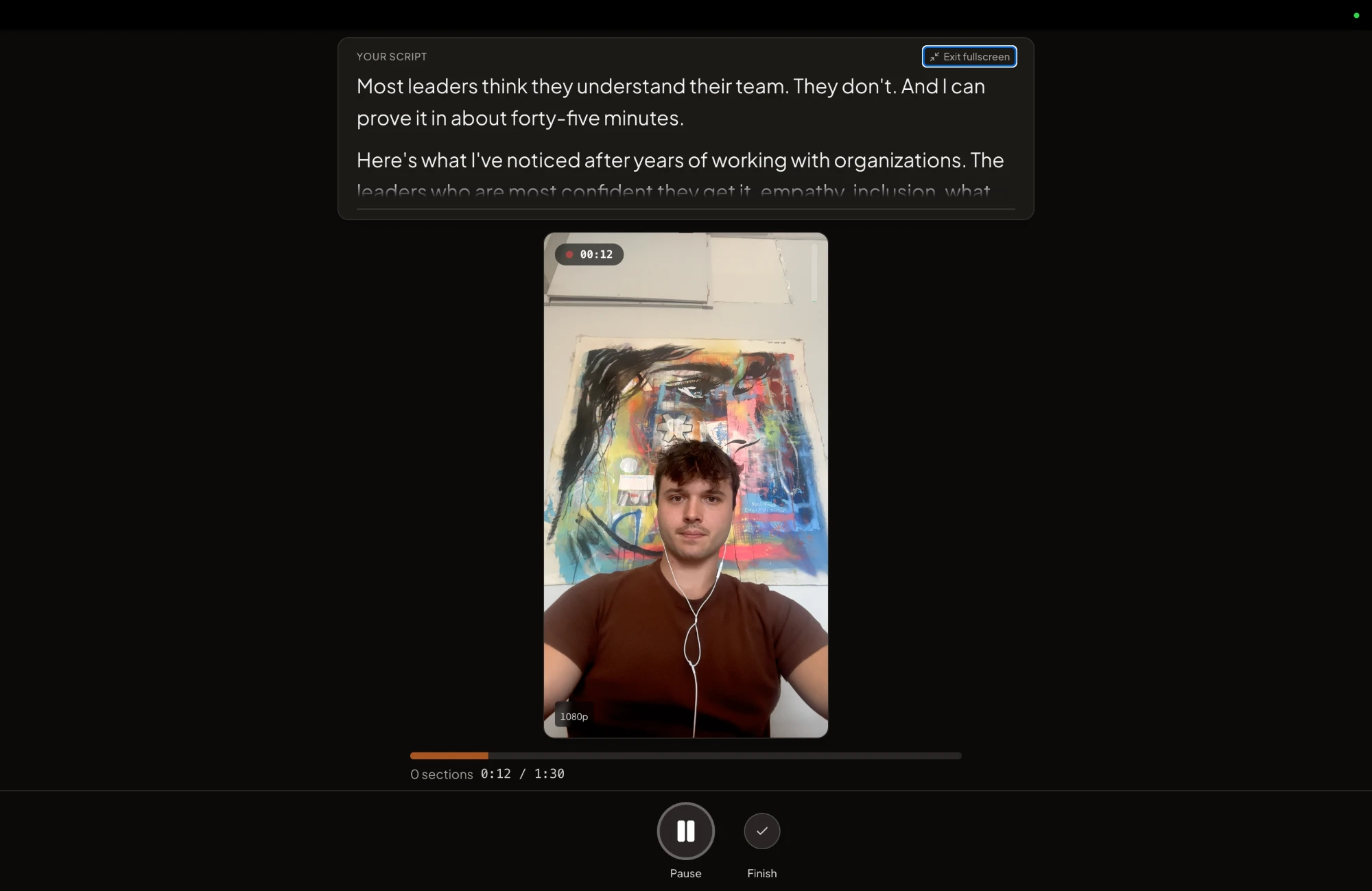
In CreateSocial, your talking points sit on a teleprompter near the lens, and each section gets a one-tap retake. Record at your desk, or prop the iPhone app on a shelf. Dual mode frames 16:9 and 9:16 in the same take, so one recording covers YouTube and Reels.
Every video should also become writing, for people who never press play. One answer becomes a page on your site that turns up when someone nearby searches "do I need a referral to see a chiropractor." It also becomes an email that reminds past patients you exist. CreateSocial writes both from the video, in your voice, plus LinkedIn posts and X threads. You check the clinical points and send.
Send one video a week to a gym, trainer or doctor nearby
Find the people who meet your future patients first: trainers, gym owners, running clubs, yoga studios, massage therapists and family doctors. Once a week, send one of them a video that helps their people, with a short note:
Hi [name],

A lot of your [members / runners / clients] ask about
[lower back tightness / sore hips after long runs].
I made a 60-second video on it they might like:
[link]

If any of them want it looked at, I'm at [clinic],
[five minutes] from you. Happy to answer questions first.

Dr. [name], [phone]
Ask every patient for a Google review the same way, and offer nothing in return. Google says "more reviews and positive ratings can help your business's local ranking," and a review is word of mouth a stranger can read.
Keep the step from video to booking short. Your profile needs one line on who you help and where, and one link to book. It's the same chain I lay out for coaches, from a Reel to a booked call. One clinic told r/Chiropractic it asked Facebook and Instagram ad leads for a card number to hold the appointment. The result: "not one person has said yes to giving us their card to reserve an appointment." Someone who has watched you explain their back needs a booking link, not a form.
Ads come last. I think of paid as a volume knob: once a video brings calls, put money behind that one.
A month on the calendar, and the hour a week that keeps it going
Here's a month for a hypothetical one-chiropractor clinic that sees desk workers, runners and people over 50. Three videos a week, and Wednesday is always a decision video.
| Week | Monday | Wednesday (decision) | Friday |
|---|---|---|---|
| 1 | Authority: "[Town] desk workers: if your lower back is tight by 3 p.m., check these three things" | "Never been to a chiropractor? Here's your first visit" | Personal: "Why I became a chiropractor" |
| 2 | Authority: "Training for the [local race]? The question I get every spring" | "When I'd send you to your doctor instead of adjusting you" | Proof: "What the physicians' guideline says about low back pain" (8 minutes on YouTube) |
| 3 | Reaction: your take on a viral posture hack | "Do you need a referral to see a chiropractor?" | Personal: "A day at [clinic], from the first patient to the last" |
| 4 | Authority: "Parents in [town]: what I look at when you bring in a teenager" | "What a first visit costs at [clinic], and what insurance covers" | Proof: "What I see on almost every desk worker's first visit" (10 minutes on YouTube) |
Every short one goes to Facebook, Instagram and YouTube Shorts from one recording, and the runner and reaction videos go to TikTok too. The two long proof videos also become blog posts and the month's patient email. In week 1, the gym note goes to three trainers near the clinic.
After that, the work is about an hour a week. Add "How did you hear about us?" to your booking form so Friday has real answers, and print this card for the front desk:
ONCE A MONTH
  Last week    Thinking hour (1 hour): 12 patient
               questions, a hook and 3 points each
  First week   Recording afternoon (3 to 4 hours):
               record, edit, write, schedule

EVERY WEEK
  Mon  10 min  Look over the week's posts
  Tue  15 min  Reply to comments and messages
  Wed  15 min  Send one video to one local partner
  Thu  10 min  Ask this week's patients for a review
  Fri  15 min  The count

THE COUNT, WEEK OF ________
  First visits booked: ___
    Patient or friend ___   Google or Maps ___
    Facebook or Instagram ___   YouTube ___
    Trainer, gym or doctor ___   Ads ___
  Video they mentioned: ________
  Question I heard twice: ________
Count first visits, not views. Ten thousand views from three states away book nobody. The card's last line is next month's recording list. Then give it three to six months before you judge it, the same window I give speakers in that speaking-gigs video.
How CreateSocial runs a clinic's content month
CreateSocial helps chiropractors build a personal brand that brings in new patients, referral partners and invitations to speak, without content eating your evenings. It learns what you know and runs the whole content week, video and written: ideas, scripts, posts, recording, editing, thumbnails and scheduling. Here's the calendar above, inside it:
- The thinking hour starts half done. Your clinic website (scan it and pick the pages), past videos and your list of patient questions go into your knowledge base. Out come 80 personalized ideas a month, each with a hook and talking points or a full script. "Ask me first" asks you questions before it writes, ending with something real you've seen.
- Record after your last adjustment. The teleprompter sits near your lens, scrolled by hand or at a pace you set. Each section gets a one-tap retake, on your computer or the iPhone app, and Dual mode frames YouTube and Reels in the same take.
- The edit is mostly deleting words. Delete words from the transcript and they're cut from the video. Remove Silences takes out the pauses in one click. Subtitles go on in one of 11 styles, for whoever is watching in a waiting room with the sound off.
- Your gym talk becomes a week of clips. Upload a recording of a talk you gave at a gym or an office. Find Clips suggests the moments that stand on their own, each cut into its own vertical video with subtitles.
- Each video becomes the written posts. A blog post, an email to your patient list, LinkedIn posts and X threads, all in your voice. Refine any draft in its chat, or start one from your knowledge base with no video at all.
- The month goes out while you're with patients. Schedule to TikTok, Instagram, YouTube, LinkedIn, Facebook and X with a caption written for each, and we post it for you once your accounts are connected. The Analytics page collects views, likes, comments, shares and followers from your connected TikTok, Instagram, YouTube, LinkedIn and Facebook accounts, so the Friday card gets its other half.
Also in the one plan: Trending Now with what your niche is talking about every Monday, competitor tracking, LinkedIn carousels with PDF and PNG export, YouTube thumbnails made from your video and photos of you, eye contact correction, B-roll from free stock video, screen recording with your camera as a bubble, reaction videos in Layout or Stitch mode, virtual backgrounds with or without a real green screen, and platform safe-zone guides for TikTok, Reels and Shorts.
Patients pick a chiropractor they can talk to. You get the same deal here. I'm Ben Moore, and I built CreateSocial on my own, bootstrapped, here in Cincinnati, Ohio, so you talk to me directly. Feature requests come to me, and a lot of what customers ask for gets built. Before CreateSocial, my agency generated millions of followers and millions of dollars in revenue for its clients, and I've generated hundreds of millions of views.
It costs $129 a month, or $99 a month billed annually, with no add-ons or per-feature charges. Start your free trial and have your first-visit video on your profile by Friday. Rather plan the first month together? Book a free strategy call with me.
Start this week: one line, one video, one note
- Write your focus line: one kind of patient, one town.
- Record your first-visit video and pin it to every profile. A free CreateSocial trial gives you the teleprompter and sections for it.
- Send it with the gym note to one trainer near you, and add "How did you hear about us?" to your booking form.
Then listen for the first new patient who says "a friend sent me your video."
Questions people ask
How do chiropractors get new patients?
Through word of mouth, local Google searches and referrals from people patients already trust, like trainers and family doctors. Short videos help all three, because a patient can forward one to a friend and someone nearby can find you explaining their problem before they call.
What should a chiropractor post on social media?
Answers to the questions patients ask at the front desk, three short videos a week. Make at least one a week a decision video, like what a first visit looks like or whether you need a referral, and name your town in every one.
What is the best marketing for chiropractors?
Word of mouth, plus anything that helps it travel. Give patients and local partners a short video they can forward, ask every patient for a Google review the same way, and post answers to the questions people in your town ask. Put ad money behind a video only after it already brings calls.
Is there free marketing for chiropractors?
Yes. A complete Google Business Profile, reviews from patients, short videos filmed on your phone and a note to the gyms and trainers near you cost time, not money. Plan the month in an hour and film it in one afternoon so the time stays small.
What is the best social media for chiropractors?
Facebook and YouTube reach the widest range of back pain patients. In Pew Research Center's 2026 survey, 78% of adults aged 30 to 49 used Facebook and 91% used YouTube. Add Instagram for patients under 30, since 79% of that age group used it.
Should chiropractors post adjustment videos?
They can pull big view counts, but most of those viewers live too far away to book. A video that names your town and answers a local patient's question gets fewer views and more calls from people who can actually come in.