

The short answer (updated November 2026):
- A personal branding statement is one sentence that tells the right buyer who you help, the problem you fix and the result they get. The formula: I help [one kind of client] [fix one problem] so they can [the result they'd pay for].
- Write it for the one person who would hire you. If the line could sit under a thousand other names in your field, it is too vague.
- Keep two versions: one line that fits a LinkedIn headline's 220 characters, and two or three sentences that add your point of view and one piece of proof.
- Before it goes live, ask two questions. Would your best client say "that's me"? Would it still be true under a competitor's name? If the second answer is yes, rewrite it.
- Use the same line everywhere a buyer checks you: your LinkedIn headline and About section, your Instagram and X bios, your website, your speaker intro and the first sentence of your intro video.
Someone hears your name, looks you up and reads the line under it. That line decides whether they read anything else.
A personal branding statement is that line: who you help, the problem you fix and what changes, in words your client would use. Here is the fill-in template, 48 examples sorted by profession, five before-and-after rewrites, three tests and the character limit for each place the line goes.
What a personal branding statement is, and the formula behind it
A personal branding statement is one or two sentences that tell a stranger who you help, with what, and what changes for them. Your job title says what you are. Your statement says who you are for, and the right buyer should spot themselves in it by the end of the line.
Write two versions. The short one goes where space is tight. The long one goes where a buyer is already reading.
SHORT VERSION (headline and bios, one sentence)
I help ________ (one kind of client, at one moment)
________ (fix one problem, in their words)
so they can ________ (the result they would pay for).

LONG VERSION (About section, website, speaker intro)
[The short version.]
[What you believe that most of your field doesn't,
 or the one way you work differently.]
[One proof a buyer can check: years, a credential,
 a book, a stage, a number.]
Here is each part filled in for a hypothetical leadership coach. Every statement on this page is one we wrote, so change the details until they describe your own clients.
| Part | Ask yourself | Too vague | Specific |
|---|---|---|---|
| Who | Who hires me fastest? | Leaders | First-time engineering managers |
| The problem | What were they doing the week they called me? | Struggling with leadership | Still rewriting their team's code at midnight |
| The result | What do they tell a friend afterward? | Reach their full potential | Leading the people who write the code |
| Point of view | What do I tell clients that peers would argue with? | Passionate about people | New managers rarely need more confidence. They need to stop doing their old job. |
| Proof | What could a buyer check? | Experienced coach | Ran engineering teams at two software companies for 11 years |
Put the first three together and you have the short version: "I help first-time engineering managers stop rewriting their team's code at midnight and start leading the people who write it." Add the last two and you have the long one.
Take the problem from your client's mouth, not your own notes. Look at what people write in the email before they hire you, or the first thing a new client says in session one. In my video on followers and clients I put the rule this way: "Your content should make your buyer feel seen before it makes you look smart." A statement is the shortest piece of content you will ever write. The rule still holds.
48 personal branding statement examples, sorted by profession
Each one names one kind of client and what changes for them. Start from the one closest to your practice and swap in your own clients' details. All 48 run 128 characters or fewer, so each fits a LinkedIn headline, an Instagram bio or an X bio as written.
Coaches
A coaching buyer can't tell most coaches apart from a headline. Name the moment that sends someone looking for help.
- I help engineers and scientists give their first conference talk without reading every word off the slides.
- I coach new VPs through their first 180 days, so the team they inherited stops routing every decision through them.
- I help mid-career teachers turn classroom skills into corporate training jobs, without starting over at entry level.
- I help solo service owners stuck at $150,000 a year raise their prices and let go of the clients who drain them.
- I help men in their 50s who just sold or left the company they built work out what the next ten years are for.
- I help desk-bound dads over 40 get strong enough to carry their kids without their back paying for it.
Once the line is set, split it into five content pillars so every post you write sits under it.
Consultants
A consulting buyer is spending a budget. They want to see their kind of company and a cost they already worry about.
- I help family-owned distributors cut order errors before a big customer starts shopping for a new supplier.
- I help startups of 30 to 100 people write their first pay bands before a raise conversation turns into a resignation.
- I help B2B software companies with no marketing hire turn what sales hears on calls into posts buyers read before a demo.
- I'm a fractional CFO for restaurant groups with three to ten locations, so owners can see which location pays for the others.
- I help medical practices with under 20 staff lock down patient data before an insurer or auditor asks how.
- I help hospitals roll out new software without the nurses inventing workarounds in week two.
The line is step one. The rest of a consultant's personal brand covers the proof assets and the speaking invitations that follow it.
Lawyers
People look up a lawyer on a bad day. Name the situation, and say what working with you is like, never how the case will end.
- I help parents of young children write a will and choose a guardian, explained in plain English from the first call.
- I represent Texas employees who think they were fired for reporting a problem at work, and I answer my own phone.
- I write the client contracts small creative agencies send, with the scope spelled out before any work starts.
- I help U.S. tech startups sponsor their first hires from abroad, and I map every visa step before the offer goes out.
- I help divorcing parents put a custody schedule in writing, down to holidays, pickups and school breaks.
For what to post under the line, see a content system built for lawyers.
Accountants and bookkeepers
Accountants win on niche. A kind of seller, a trade or a tax situation tells a buyer you have seen books like theirs before.
- I do the books and taxes for Etsy and Shopify sellers doing $100,000 to $1 million a year, so sales tax stops being a guess.
- I help therapists and other solo practitioners decide whether an S corp saves them money, then run the payroll for it.
- I'm a CPA for Americans living in Europe who owe returns in two countries and want one person handling both.
- I help construction subcontractors price jobs on real labor costs, so a busy year is also a profitable one.
- I clean up two or three years of messy books for startup founders before they sit down with investors.
A niche like these is a year of topics, and this 12-month calendar for accountants lines them up with the tax deadlines.
Therapists and counselors
A therapy client is looking for someone who understands their situation. Name it gently, and leave out promises about how they will feel.
- I work with couples in the first two years after a baby who keep having the same fight at 11 p.m.
- I work with anxious teenagers whose school mornings start with a stomachache, and give their parents a clear part to play.
- I'm a therapist for firefighters and paramedics who want to talk about what they saw on shift with someone who knows the job.
- I help adults diagnosed with ADHD in their 30s and 40s build a work week that fits how their brain runs.
- I help adults in Minnesota through the first year after losing a parent, online, with evening sessions.
Video does the rest of the trust-building. Here is how therapists fill a caseload with video.
Financial advisors
An advisor who names a life event gets found by people living through it. Describe the decision you help with, never a return.
- I help public school teachers plan retirement around their pension, so they know what they can spend in year one.
- I help tech employees with stock options decide when to sell, and plan for the tax bill before it arrives.
- I help widows in their 60s make their first money decisions on their own, at a pace they set.
- I help owners who plan to sell their business in five years work out what the sale has to pay for.
- I help doctors in their first five years out of residency pay down loans and start investing at the same time.
Each of those life events is also a month of videos. The life-event video plan for advisors lays them out.
Speakers and authors
An event planner reads your line for two things: who the audience is, and what changes in the room.
- I give keynotes to sales teams on asking better questions, and every session ends with a script reps use on Monday's calls.
- I speak to manufacturing leaders about safety culture, from 14 years on plant floors and five years running one.
- I wrote the book on meetings people don't dread, and my workshops get a team running them that way the same week.
- I speak at association conferences about handing a family business to the next generation, from my own family's handover.
- I give the post-lunch talk on change fatigue that conference planners book when they need the room awake.
Your line opens the speaker sheet, too. How to get paid speaking gigs covers the rest of it.
Founders
A founder's statement sells the founder first. Say what you are building, who it is for and why you are the one building it.
- I'm building scheduling software for home health agencies, because I spent six years watching nurses drive past each other.
- I run a bootstrapped design studio, and I write about growing a services business without outside money.
- I started a gluten-free meal kit after my celiac diagnosis, and I share what it takes to run a food brand that can't slip up.
- I run a two-person newsletter business for HR leaders, and I share our subscriber and revenue numbers every month.
- I help first-time climate tech founders raise a first round, using the deck and the numbers from my own raise.
Short on time to post behind it? Here is a month of founder content in one afternoon.
Other experts
The same shape works for any practice that sells your time or your judgment.
- I help people relocating to Columbus for work buy a home before their start date, without flying in five times.
- I'm a dentist for adults who haven't been in for years, and nobody here will lecture you about it.
- I'm a physical therapist for runners over 40 with knee pain who want to build back to their weekend long run.
- I place finance leaders at private equity-backed companies, and I tell candidates what the deal means for them before they sign.
- I'm a registered dietitian for people with type 2 diabetes who want meals the whole family will eat.
- I teach freelance bookkeepers to sell monthly plans, so their income stops depending on tax season.
Five rewrites that turn a vague statement into a specific one
Most weak statements describe the expert and leave out the client. Each rewrite below trades the adjectives for a person and the moment they need you.
| Before | After | What changed |
|---|---|---|
| "Helping you live your best life." (life coach) | "I help new retirees who miss having somewhere to be build a week they look forward to." | "You" became one group at one turning point. |
| "Strategic growth consultant. Driving results through innovation." (business consultant) | "I help owner-run HVAC companies add a second crew without the owner working Saturdays again." | A real kind of company, a real milestone and the cost the owner dreads. |
| "Experienced attorney dedicated to excellence." (estate planning lawyer) | "I help blended families write a will that provides for the kids from both marriages." | Two qualities every lawyer claims, swapped for one worry a family has. |
| "Compassionate, client-centered therapist helping you heal and grow." (therapist) | "I work with new managers who lie awake replaying the day's meetings and can't switch off after work." | Three adjectives out, one scene a reader can picture. |
| "Comprehensive wealth management for discerning clients." (financial advisor) | "I help couples who retire early work out how to pay for health insurance until Medicare starts." | A gap in their plan they can name, in place of a service menu. |
Every "before" on that list could sit under a thousand other names.
A statement that could fit 1,000 coaches fits none
The safest-looking statement is the riskiest one you can write. "I help leaders grow" offends nobody, and that is why nobody stops on it.
The 2025 ICF Global Coaching Study counted a record 122,974 coach practitioners worldwide. A line that fits a thousand of them gives a buyer no reason to pick you. And buyers do see you side by side. LinkedIn Help says your headline is "displayed in search results", so someone searching "leadership coach" reads a column of them. A generic line disappears into it.
I call this qualified attention: the right people noticing you and trusting you with their problem. As I said in my Instagram strategy video, "A thousand people who will never hire you isn't a business. 40 of the right people are." Your statement is where you pick those 40. Why 10,000 of the wrong followers can still bring zero clients makes the full case.
The objection is fair. Narrow feels like turning work away. It isn't. You can take any client you like. The statement only decides what people remember you for, and a person can't pass a vague line on to a friend who needs you.
Three tests before your statement goes live
Run these before the line goes on any profile. Each takes a few minutes.
- The recognition test. Read the line to a past client, or to someone who fits your best client. Don't explain it first. If they say "that's me" or "that's my friend", it works. If they ask what it means, it doesn't.
- The swap test. Put a competitor's name in front of your line. If the sentence is still true, it is not yours yet. Then search LinkedIn for your job title and read the first ten headlines. If yours would blend in, add the moment or the result only you would name.
- The out-loud test. Say it as your answer to "So what do you do?" at a dinner. If you would never say those words out loud, swap the jargon for the words your client used in their first email.
A line that passes all three is ready. Expect to rewrite it a few times as your clients change. A statement is a working draft, and the people who reply to it are the best editors you have. Turning those replies into booked calls is the next skill.
Where to use your personal branding statement, and how long each spot allows
Use the same statement everywhere a buyer checks you, short version or long. A buyer who sees one line on LinkedIn and a different one on your website starts to wonder which is true.
| Where | Which version | Limit | Source |
|---|---|---|---|
| LinkedIn headline | Short, in place of your job title | 220 characters | LinkedIn Talent Blog (2025) |
| LinkedIn About section | Long version as the opening lines, then the detail | 2,600 characters | LinkedIn Talent Blog (2024) |
| Instagram bio | Short | 150 characters | Instagram Help Center |
| X bio | Short | 160 characters | X Help Center |
| Your website | Short as the first line on the home page, long version under it | None | Your own page |
| Speaker introduction | Long, written for the host to read aloud | None | Your speaker sheet |
| Intro video | Short, as your first sentence on camera | None | Your script |
Checked against LinkedIn, Instagram and X on November 17, 2026.
LinkedIn's own help page on headlines says yours "can be separate from the title of your current position." Use that. "Executive Coach, Founder" tells a buyer your title. Your statement tells them whether to keep reading. For the rest of an Instagram profile, from the name field to pinned posts, see our Instagram bio guide for coaches.
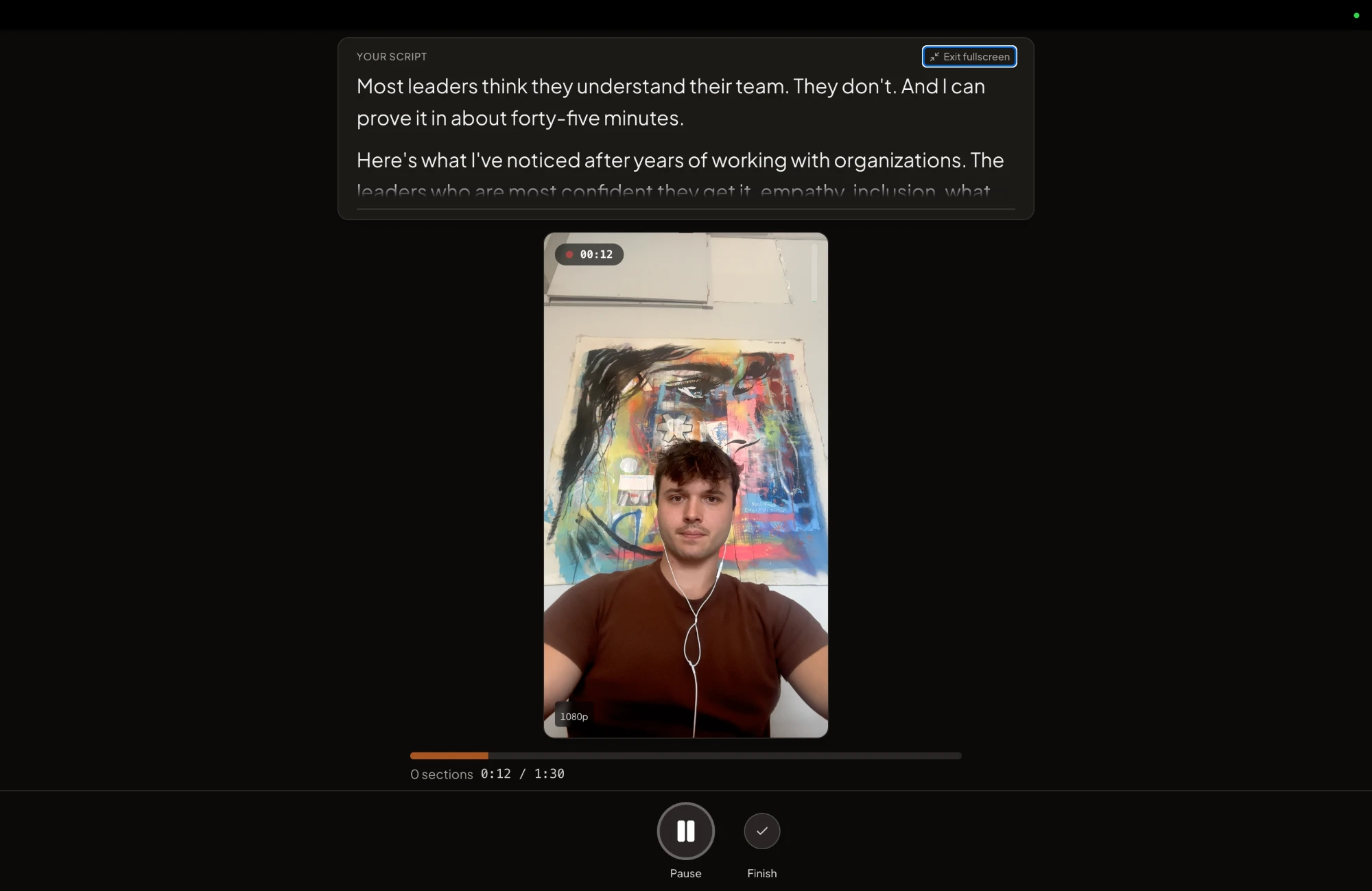
Don't skip the intro video. Open it with the short version, word for word, then spend a minute on the problem and one on how you work. In CreateSocial you can put that script on a teleprompter near your camera and record it in sections, so a stumble on line two costs you one section, not the take. Dual mode frames 16:9 and 9:16 at once, so the same recording works on LinkedIn and on your vertical feeds.
Information is cheap now, so your statement needs your point of view
The long version's middle sentence, what you believe, deserves the most work. Anyone can get a decent general answer to a tax, legal or leadership question in seconds. What they can't get is your read on their situation.
I opened my video on showing your face with this: "If you are in a business where people hire you for what you know, I mean lawyers, accountants, doctors, authors, speakers, coaches, right now is the number one time to be building a personal brand because with AI coming, all this information out there is going to start to become commodified."
So the statement can't carry the brand alone. It makes the promise, and your content proves it. As I put it in my reaction-video breakdown, "People don't just want to know that you have knowledge. They want to see how you apply it." I rotate four kinds of post to show that: authority, proof, process and personal (the mix in a founder's weekly content plan). Here is example 2, the coach for new VPs, turned into one of each:
| Kind of post | What the buyer learns | A post for "new VPs in their first 180 days" |
|---|---|---|
| Authority | You understand the problem | "Why your old team still brings every decision to you, and the meeting that changes it." |
| Proof | It has worked for someone like them | "A pattern from three VP clients this quarter, details changed: the decision each one kept and the one each gave back." |
| Process | What working with you is like | "Week one of coaching: the decision audit we run before anything else." |
| Personal | Who you are | "The decision I held on to too long in my first VP job, and what it cost my team." |
Every one of those posts restates the line without repeating it. A month of them does more for the statement than any rewrite. For more angles, 28 LinkedIn post ideas for coaches and consultants gives an opening line for each, sorted by goal.
This is where CreateSocial keeps you on message. Put your statement's parts into About you at the top of your Knowledge Base page, and every idea is built from that profile and what you have added. Month six is still aimed at the same buyer as month one.
How CreateSocial keeps every post on your statement
CreateSocial helps experts build a personal brand that brings in clients, speaking gigs and customers, without content taking over the week. It learns what you know, then runs the whole content week with you, video and written: ideas, scripts, posts, recording, editing, thumbnails and scheduling. Set your statement once, and every idea, script and post starts from it.
- Your statement becomes the brief. Fill in About you once: what you do, who it's for, how you talk, your topics and what you sell. Add your website, YouTube, Notion, Google Drive, documents, past videos and posts, client stories and competitor videos to your knowledge base. Ideas use all of it, with your industry, audience, tone and content pillars.
- Your point of view goes in early. The "Get to know you" interview asks about your clients, what you tell them and where you stand. A weekly check-in keeps adding to it. When you want a script built on a real moment, "Ask me first" asks you questions before it writes, and the last one is always about a real story or something you have seen.
- The month's ideas are already on brand. You get 80 personalized ideas a month with hooks, talking points or full scripts. Your Topics rotates up to six topics from your knowledge base, so you cover every area instead of the same few. Trending Now adds what your niche is talking about every Monday, and competitor tracking brings in new posts from the profiles you follow.
- Written posts sound like you. LinkedIn posts, X threads, blog posts, emails to your list and LinkedIn carousels you export as a PDF or PNG, all in your voice from your knowledge base, with no video needed. Refine a post in its chat, or a carousel one slide at a time.
- The proof gets recorded in one sitting. Read from a teleprompter near your camera, at your desk or on the iPhone app, one section at a time with one-tap retakes. Then edit by deleting words from the transcript, Remove Silences in one click, fix eye contact and add subtitles in 11 styles.
- It all goes out from one calendar. Schedule to TikTok, Instagram, YouTube, LinkedIn, Facebook and X, each with a caption written for that platform, and we post it for you once your accounts are connected. The Analytics page shows what landed, and "Make another like it" turns a post that did well into a new idea.
Also in the one plan: Dual mode for 16:9 and 9:16 in one take, screen recording with your camera as a bubble, reaction videos in Layout or Stitch mode, green screen and virtual backgrounds with or without a real green screen, B-roll from free stock video, Find Clips for pulling standalone clips out of a long talk or webinar, YouTube thumbnails made from your video and photos of you, and platform safe-zone guides.
A good statement tells people exactly who they will be dealing with, so here is mine. I'm Ben Moore, and I built CreateSocial on my own, bootstrapped, here in Cincinnati, Ohio, so you talk to me directly. Feature requests come to me, and a lot of what customers ask for gets built. Before CreateSocial, my agency generated millions of followers and millions of dollars in revenue for its clients, and I've generated hundreds of millions of views.
It's $129 a month, or $99 a month billed annually, with no add-ons and no per-feature charges. Start your free trial, put your statement into About you, and see a month of ideas built around it. Want help sharpening the line first? Book a free strategy call with me.
Write yours in the next 20 minutes
- Open the last three emails a new client sent before hiring you. Underline how they described the problem.
- Fill in the short version of the template with those words.
- Run the swap test. If a competitor could sign it, add the moment or the result.
- Read it to one past client and ask what they think it means.
- Put it in your LinkedIn headline today, and open your About section with the long version.
Then record a one-minute intro that starts with the line. A free CreateSocial trial gives you the teleprompter for it, and a month of ideas that stay on your statement.
Questions people ask
What is a personal brand statement?
It is one or two sentences that tell the right buyer who you help, the problem you fix and what changes for them. It goes in your LinkedIn headline, your bios and the first line of your website.
How do you write a personal brand statement?
Name one kind of client, the problem they would describe in their own words and the result they would pay for, in one sentence that starts with "I help". Then read it to a past client, and check that it would not fit a competitor just as well.
Can you give me an example of a brand message?
For a change management consultant: "I help hospitals roll out new software without the nurses inventing workarounds in week two." It names a buyer, a moment they dread and the result, which is what makes a brand message stick.
How long should a personal branding statement be?
One sentence for the short version, so it fits a LinkedIn headline, which allows 220 characters. Keep a longer version of two or three sentences for your About section, your website and the introduction a host reads before you speak.
How would you describe a personal brand?
Your personal brand is what a buyer can find out about you before you meet, plus what past clients say when someone asks them who to call. For an expert, the test is simple. When someone mentions the problem you fix, does your name come up?
How do you create a personal brand for yourself?
Write your statement first and put it everywhere a buyer checks you. Then publish something every week that shows the statement is true, such as answers to client questions, your process and your point of view. Judge it by who gets in touch, not by follower counts.