

The short answer (updated November 2026):
- Marketing for insurance agents works when people in your town know your face before they need an agent. Short videos timed to the moments they need you do that: the morning after a storm, the day a renewal jumps, Medicare's fall window.
- Plan around three kinds of moments: dates on everyone's calendar, dates you know for each client, and the ones nobody schedules. Film the storm video before the storm.
- Explain one confusing policy term per video. The NAIC's own example: a 5% named storm deductible on a $300,000 house is $15,000 out of pocket.
- Start on Facebook and YouTube for home, auto and Medicare clients, and put every video on every platform.
- Send policyholders the right video at the right moment, with a text they can forward. That's how a happy client becomes a referral.
You pay for leads, and the person who answers has no idea who you are. Your best clients didn't come that way. They knew your name before they ever called.
Marketing for insurance agents works when your town knows your face before it needs an agent, so you're the one they call after the storm, the rate increase or the 65th birthday. This page has a calendar of those moments, the storm and renewal scripts, ten policy terms to explain on camera, two texts policyholders will forward and a month planned out.
Insurance gets bought at moments, so be known before one hits
People shop for insurance when something happens: a hailstorm, a renewal letter, a teenager's new license, a lease on a first storefront. In that moment they call whoever they already trust. If nobody comes to mind, they search, and a stranger gets the call.
That doesn't take a big audience. It takes the few hundred households in your ZIP codes seeing you most weeks. I call that qualified attention. Three hundred neighbors who know your face beat 30,000 views from states you don't write in.
Nor do you need to become an influencer. "We're not using social media to become a social media influencer, I'm guessing. So, why would you be spending all of your time on social media? You are using it as a utility to grow your brand, to grow your personal brand, to get yourself out there," as I say in my video on putting your face on your business. For an agent the utility is plain: be the familiar face in town.
Plan around three kinds of moments, then fill the calendar
Sort every video by the kind of moment it meets, because each kind is planned differently.
- Dates on everyone's calendar. Medicare's fall window, HealthCare.gov's open enrollment, hurricane season. Post these a week or two before the date.
- Dates you know for each client. A renewal, a teenager's license, a home closing, a new business, a 65th birthday. Post these, and send the home, auto and business ones to the client they fit.
- Moments nobody schedules. A storm, a fender bender, a renewal that jumped, a viral claim about insurance. Film these ahead and post them the day they happen.
The first kind is the easiest to plan. The second is where referrals start. The third wins the town, because the morning after a storm, people search for what to do.
Here's the year. Reword the hooks and add your town's own moments, like the week the river rises.
| Moment | When to post | Lines | Hook | Source |
|---|---|---|---|---|
| Hurricane season starts | May, before the June 1 start (Atlantic season runs to November 30) | Home, flood | "Hurricane season starts June 1. A new flood policy usually takes 30 days to kick in." | National Hurricane Center, FEMA FloodSmart |
| Medicare Open Enrollment | October 15 to December 7 | Medicare | "Medicare's fall window closes December 7. Here's what I'd check before then." | Medicare.gov |
| HealthCare.gov Open Enrollment, 2027 coverage | November 1 to January 15 | Health, under 65 | "Want coverage that starts January 1? On HealthCare.gov, enroll by December 15." | HealthCare.gov |
| A client turns 65 | Their first window opens 3 months before the birthday and lasts 7 months | Medicare | "Turning 65 this year? Miss your first Medicare window and you may pay a penalty for as long as you have Part B." | Medicare.gov |
| A renewal is coming | 30 days before the renewal date | Home, auto, commercial | "Your renewal shows up next month. Three questions to ask before it does." | Your book of business |
| A teenager gets a license | Any month, and again before school starts | Auto | "Your kid just got their license. Here's what changes on your auto policy." | Your book of business |
| A home closing or a new mortgage | The weeks before closing | Home, life | "Buying a house? Ask these three insurance questions before you sign." | Your book of business |
| A new business or a first lease | Any month | Commercial | "Signing your first commercial lease? Read the insurance section before you sign." | Your book of business |
| A storm hits your area | The next morning | Home, auto | Script A below | NAIC |
| A fender bender | Pinned, and ready to text | Auto | "Just had your first fender bender? What to do in the first ten minutes." | NAIC |
| Renewals jump | The week renewal notices go out | Auto, home | Script B below | BLS, NAIC |
| A viral claim about insurance | While it's trending | Any | "This video says [the claim]. Here's what it leaves out." | Your feed |
Checked against Medicare.gov, HealthCare.gov, the National Hurricane Center and FloodSmart on November 9, 2026. If your state has its own Marketplace, use its dates. More first lines are in these video hook examples.
Film the storm video before the storm
The night a storm hits, you won't film anything. You'll be on the phone. So record the unscheduled moments ahead and keep them in a drawer: a storm video, a fender-bender video and a renewal video, edited and ready. The morning after is the worst time to start from zero and the best time to post.
Script A follows the NAIC's claim guidance and its warning about contractor paperwork. Record each numbered block as a separate section, so a fumbled line means redoing one block.
SCRIPT A: THE MORNING AFTER A STORM
About 75 seconds. Five sections.
Film it now, post it the morning after.

1. HOOK
   If last night's storm hit your house,
   do these four things before anyone
   starts fixing it.

2. PHOTOS FIRST
   Before you move anything, take photos
   and video of the damage. Room by room,
   then the roof line and the yard.
   Save damaged items if you can.

3. STOP IT GETTING WORSE
   Cover the hole in the roof. Board up
   the broken window. Keep every receipt.
   When the damage is covered, those
   costs usually are too.

4. CALL TODAY, SIGN CAREFULLY
   Most insurers have a time limit for
   reporting a claim, so call today.
   And read anything a contractor hands
   you before you sign. Some forms sign
   over your benefits.

5. ASK
   Not sure what your policy covers?
   Text me "STORM" at [number].
   I'm [name] at [agency], here in [town].
CreateSocial puts the script on a teleprompter right by your camera, with a one-tap retake for each block. Then the video waits in your library. When the forecast turns, schedule it for 7 a.m. and go look after your clients.
Answer "why did my rate go up?" before the renewal lands
A renewal with a bigger number on it is when a client starts collecting other quotes. Get there first with a video that explains the increase, and the call comes to you instead of a comparison site.
The national number makes the hook. The Bureau of Labor Statistics' price index for motor vehicle insurance fell 5.0% from September 2025 to September 2026, the latest month out when we checked on November 9, 2026. So a client whose renewal went up wants to know why theirs didn't follow. The NAIC's list of premium factors has the answer: tickets and crashes, claims, where the car is kept, the car and what it costs to fix, and the coverage and deductibles chosen.
SCRIPT B: WHY DID MY RENEWAL GO UP?
About 60 seconds. Four sections.
Post it the week renewal notices go out.

1. HOOK
   Auto insurance prices fell about 5%
   nationally in the year to September.
   [Swap in the latest BLS figure
   and month before you record.]
   If your renewal went up anyway,
   here's what I'd check.

2. WHAT CHANGED ON YOUR SIDE
   A ticket. An accident. A claim.
   A new driver, a different car, a move.
   Any one of them can move the price.

3. WHAT CHANGED AROUND YOU
   Where you live and park the car counts.
   So does what it costs to fix cars
   like yours in [your area].

4. ASK
   Text me a photo of your renewal page
   at [number]. We'll go through it line
   by line, and see if a different
   deductible or a discount helps.
Script B promises a look, never a lower price, and a look is the start of a review. Keep a home version ready too, built around your area's storms and rebuilding costs.
Explain one confusing policy term per video
Policy language is where people feel lost, and lost people call whoever explained it best. Do one term a week, a minute each, reading from your carrier's actual policy form.
| Term | What people ask | Hook | Line | Source |
|---|---|---|---|---|
| Named storm deductible | "Is my deductible really $1,000?" | "Your hurricane deductible might be $15,000, not $1,000. Here's the math." | Home | NAIC: 5% of a $300,000 house is $15,000 |
| Replacement cost vs. actual cash value | "Will they pay for a new roof?" | "Same storm, same roof, two very different checks. It comes down to a few words on your policy." | Home | NAIC: actual cash value is after depreciation |
| Flood coverage | "Doesn't my home policy cover flooding?" | "Most home policies don't cover flood. Here's what does." | Home | FEMA FloodSmart |
| Additional living expenses | "If we can't live at home, who pays for the hotel?" | "If a fire puts you in a hotel for three months, here's what your policy pays, and what it doesn't." | Home | NAIC: some policies cap the dollars or the months |
| Auto liability limits | "What do those three numbers mean?" | "The three numbers on your auto policy, explained in one minute." | Auto | Your carrier's policy form |
| Uninsured motorist coverage | "What if the other driver has no insurance?" | "The driver who hit you has no insurance. Now what?" | Auto | Your carrier's policy form |
| Umbrella policy | "Do I need one?" | "What an umbrella policy covers that your home and auto policies don't." | Home, auto | Your carrier's policy form |
| Medicare Advantage vs. Medigap | "Which one should I pick?" | "Medicare Advantage or a Medigap plan? The question I ask before either one." | Medicare | General only, no plan names |
| Term vs. whole life | "Is whole life a scam?" | "Term or whole life? Start with how many years you need the coverage." | Life | Your carrier's product guide |
| Business owner's policy | "What does a BOP cover?" | "What a business owner's policy covers, and [the gap you see most often]." | Commercial | Your carrier's policy form |
Each one lands harder with a real case, details changed. "My client's roof was 15 years old" beats a definition. In CreateSocial, "Ask me first" questions you before it drafts the script, always ending on something real you've seen, so the explainer opens on a claim you actually handled.
Then react to the insurance advice going around online. "Some of it is great. Some of it is incomplete. Some of it is oversimplified. And some of it is just wrong," as I say in my video on reaction content. If a client forwarded you the clip and you'd have a real answer, film it. Reaction videos for coaches shows the format, and it carries straight over to agents.
Will AI replace insurance agents?
The government expects more agents, not fewer. BLS projections have insurance sales agent jobs growing from 572,600 in 2025 to 591,400 in 2035. That's 3.3%, close to the 3.5% for all jobs. The same agency says "agents will still be needed to help clients understand their options and choose a policy that is right for them."
What loses value is the plain definition. Anyone can ask a chatbot what a deductible is. Nobody can ask it what you'd do about their roof, their teenager and their flood zone. So make every explainer show a decision.
Sell where you live: film around town and lead with Facebook
Put your town in the videos. A viewer who recognizes the intersection or the creek that floods knows you're local before you say a word.
- The street that floods every spring, filmed from the sidewalk, for your flood video.
- The empty lot where new drivers practice parking, for the teen-driver video.
- A client's shop, with the owner's OK, for your business owner's policy explainer.
- Your own desk, for "what a review with me looks like."
The CreateSocial iPhone app keeps your points on screen while you film these, and you can turn the camera around between sections to show the street.
Then pick a lead platform for each line. Pew Research Center asked 5,511 U.S. adults which platforms they use in the first half of 2026:
| Line | Who's buying | Lead with | Pew 2026: share who use it |
|---|---|---|---|
| Medicare | People turning 65, and retirees | Facebook and YouTube | Ages 65+: YouTube 65%, Facebook 59% |
| Home and auto | Homeowners and families | Facebook and YouTube | Ages 30-49: YouTube 91%, Facebook 78%. Rural adults: Facebook 76% |
| Renters and first cars | Adults under 30 | Instagram and TikTok | Ages 18-29: Instagram 79%, TikTok 65% |
| Life | Young families and new homeowners | YouTube and Instagram | Ages 30-49: YouTube 91%, Instagram 64% |
| Commercial | Business owners, plus the realtors, lenders and CPAs who refer them | LinkedIn and Facebook | Our read, not a survey figure |
Lead means where you answer comments first. Every video still goes everywhere. "On some platforms they're going to perform, on others they won't, but your content strategy shouldn't just be determined by a platform, it should be determined by you," as I put it in the face-on-camera video. If Instagram leads for your renters, schedule the Reels ahead.
Hand every happy policyholder a video to forward
Policyholders are your best source of new ones. They won't pitch you to a neighbor, but they will forward a two-minute video that helps.
Still, a book that waits on referrals waits on luck. Referrals are one of the five paths a client takes, and content is the one that feeds the rest. The video gives a happy client something to send.
Send one at four moments, to one client at a time:
- The week a claim gets paid. They're relieved, and the neighbors are asking how it went.
- Right after a review that found a gap or a discount.
- The morning after a storm, to every client on the streets it hit.
- The month before a renewal, with the explainer that fits their policy.
TEXT 1: THE MORNING AFTER A STORM

Hi [name], checking in after last night.
Everyone OK? I made a short video on
what to do first if there's damage: [link]

If a neighbor's still sorting it out,
feel free to send it on. I'm around all day.
[Your name]
TEXT 2: AFTER A GOOD REVIEW OR A PAID CLAIM

Hi [name], glad we got [the roof claim /
your renewal] sorted. Here's the short video
on [named storm deductibles] we talked
about: [link]

If anyone you know just got a renewal that
jumped, they can text me and I'll look at
it with them, no pressure.
[Your name]
Keep these texts to home, auto and business clients, and ask your carriers or agency what needs their approval before anything posts. If you sell Medicare Advantage, CMS treats posts about a plan's benefits, premiums or Star Ratings as marketing and bars unsolicited texts and direct messages, so keep those videos general.
Referral partners work the same way. Realtors and loan officers meet your next homeowner weeks before you do, and CPAs meet business owners, so send each the video that fits their clients. The realtor playbook and our playbook for accountants cover their side. If you also plan retirement income, pair your Medicare videos with the life-event plan for financial advisors.
The step after a video: one keyword text, then a 15-minute review
Keep the next step small enough to take tonight:
- The video meets someone at a moment and ends with one ask: text a keyword.
- They check your profile: your town, your lines and a pinned "what a review with me looks like" video.
- They text. You reply with one question about their situation, not an intake form. Three explainers in, they already know how you think.
- You book a 15-minute review by phone or video, and quote after it.
Pin "How I get paid, in 60 seconds" there too. It answers "How does an insurance agent make their money?", which Google's People Also Ask showed for "how do insurance agents get clients" on November 9, 2026. The short answer is commissions: the BLS says they're "the most common form of compensation, especially for experienced agents." That video is the decision stage of a content funnel, often the last one someone watches before they text.
Once a month, count texts from videos, reviews booked, referral texts answered and policies written. Ignore the likes, and don't judge any of it for three to six months.
One month for a hypothetical small-town agent, recorded in one sitting
This agent writes home, auto and health, including Medicare supplements. The month starts mid-November, while two enrollment windows overlap. It all comes from one thinking day and one recording day, which I explain in recording day vs. thinking day. Pick the moments and hooks on the first. Film everything back to back on the second, edit light and leave the drawer unscheduled.
| Week | Posted everywhere | YouTube, long | LinkedIn or email | Sent to policyholders |
|---|---|---|---|---|
| 1 | "Medicare's fall window closes December 7." The named storm deductible explainer. | "Medicare Advantage or Medigap: how I'd think it through," general, no plan names | Email to your list: a one-page year-end insurance check | Text the deductible video to homeowner clients renewing in January |
| 2 | Script B, "Why did my renewal go up?" "Doesn't my home policy cover flooding?" | None | LinkedIn post: what a business owner's policy leaves out | Send script B to every client renewing in December |
| 3 | "Want coverage that starts January 1? Enroll by December 15." A local video at the street that floods. | "Your home policy, page by page," a screen share of a sample declarations page | LinkedIn carousel: the ten terms, one per slide | Send the business owner's policy post to three business clients |
| 4 | "What a review with me looks like" (pin it). "How I get paid, in 60 seconds." | None | Email: book your year-end review | Text 2 to five happy clients, with the explainer that fits each |
Script A sits in the drawer all month. It goes out the morning after the next storm, with text 1 to every client on the streets it hit.
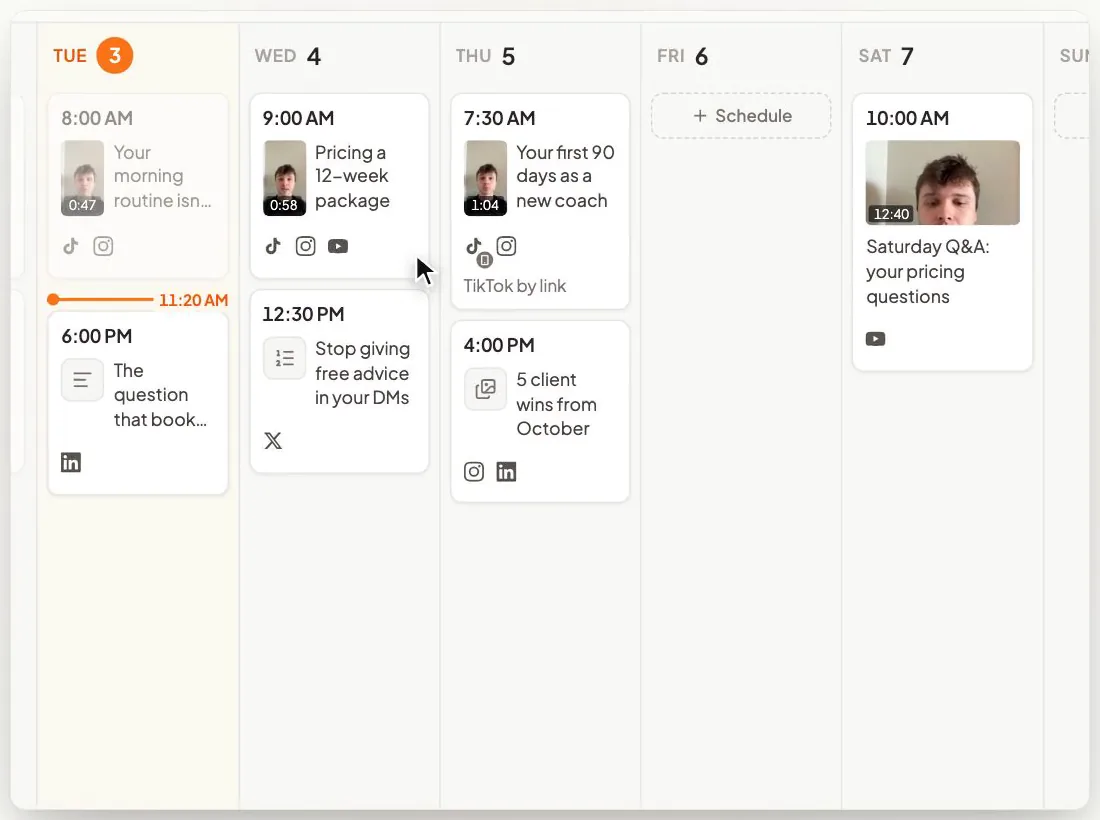
CreateSocial runs the calendar, the drawer and the posting
CreateSocial helps you become the agent your town calls first, and turns that into clients, referrals and local speaking invitations, without content taking the hours your policyholders need. It learns what you know and runs the whole content month with you, video and written: ideas, scripts, posts, recording, editing, thumbnails and scheduling.
- Ideas built from your agency. Add your agency's web pages, FAQ sheet and old newsletters to your knowledge base, and get 80 personalized ideas a month with hooks, talking points or full scripts. Each Monday, Trending Now shows what your niche is talking about, and "Ask me first" gets the real claim story out of you before it writes.
- The street, the desk and the screen. The iPhone app takes the teleprompter to the street that floods. Desk days get Dual mode, which frames YouTube's 16:9 and the 9:16 Reel in one take. For the declarations-page walkthrough, screen sharing puts your face in a bubble over the page, and your points float on top.
- An edit you can finish between calls. Strike a word from the transcript and it's cut from the video. Remove Silences closes the gaps, eye contact correction keeps you on the lens, and subtitles in 11 styles serve everyone watching on mute.
- The written side, camera optional. A recording becomes a LinkedIn post for business owners, an email to policyholders, a blog post or a LinkedIn carousel of the ten terms, exported as PDF or PNG. Skipping the camera this month? The same formats come straight from your knowledge base.
- The drawer, the posting and the proof. Script A waits in your library until the forecast turns. The rest goes on the calendar for TikTok, Instagram, YouTube, LinkedIn, Facebook and X, each with its own caption, and we post it for you once your accounts are connected. The Analytics page then measures views, shares, comments, likes and follower growth on your connected TikTok, Instagram, YouTube, LinkedIn and Facebook accounts, and "Make another like it" turns your best explainer into next month's idea.
Also in the one plan: Find Clips for standalone clips from a recorded client seminar, YouTube thumbnails made from your footage and photos of you, safe-zone guides for TikTok, Reels and Shorts, competitor tracking, X threads, reaction videos (Layout or Stitch) answering the viral insurance advice clients forward you, B-roll from your own footage or free stock video, and virtual backgrounds with or without a real green screen.
I'm Ben Moore, and I built CreateSocial on my own, bootstrapped, here in Cincinnati, Ohio, so you talk to me directly, the way your clients reach you instead of a call center. Feature requests come to me, and a lot of what customers ask for gets built. Before CreateSocial, my agency generated millions of followers and millions of dollars in revenue for its clients, and I've generated hundreds of millions of views.
It's $129 a month, or $99 a month billed annually, with no add-ons and no per-feature charges. Start your free trial and have your storm video filmed before the next forecast. Want help picking your first month's moments? Book a free strategy call with me.
Before the next forecast: two scripts and three texts
- Pick next month's three moments from the calendar.
- Film script A in sections with the teleprompter in a free CreateSocial trial, then leave it in the drawer.
- Film script B and send it to every client renewing next month.
- Send text 2 to three happy policyholders, each with the explainer that fits them.
- Start a phone note of every question clients ask this month. It's next month's idea list.
Then check the forecast. Your storm video is already waiting.
Questions people ask
How do insurance agents get clients?
Most start with people they know, referrals and bought leads. Video adds a way in that costs nothing per lead: people in your town watch you explain their situation before they need an agent, so you are the one they call when a storm, a renewal increase or a 65th birthday arrives.
What should insurance agents post on social media?
Videos for the moments people need an agent, like the morning after a storm, a renewal that went up or Medicare's fall window. Add short explainers on confusing terms, such as a named storm deductible, and local videos filmed around your town.
What is the best social media platform for insurance agents?
It depends on the line you sell. In Pew Research Center's 2026 survey, 76% of rural adults and 59% of adults 65 and older used Facebook, and 65% of adults 65 and older used YouTube, so start there for home, auto and Medicare. Add Instagram and TikTok for renters and young drivers, and post every video everywhere.
Will AI replace insurance agents?
The Bureau of Labor Statistics projects jobs for insurance sales agents to grow 3.3% from 2025 to 2035, and says agents will still be needed to help clients understand their options. In my view, AI makes general answers cheap, so agents who show their judgment on video stand out more.
How does an insurance agent make their money?
Mostly through commissions. The Bureau of Labor Statistics says commissions are the most common form of compensation, especially for experienced agents. That makes the policyholders you keep, and the friends they send you, the core of the business.
What are some good insurance agent marketing ideas?
Film a storm video before storm season and post it the morning after one hits. Explain one confusing policy term a week, send happy policyholders a video they can forward and plan around dates like Medicare's October 15 to December 7 window.