

The short answer (updated November 2026):
- Criminal defense marketing works when the person searching after an arrest, often a parent or partner, has already watched you explain what happens next. That earns more trust than a list of verdicts.
- Post one plain-English answer per stage of a case: the arrest, the jail call, the first court date, bail, choosing a lawyer, the long wait and how it ends.
- Put long answers on YouTube and Facebook, where parents are. Record separate short answers for Instagram and TikTok, which 79% and 65% of adults under 30 use. Write LinkedIn posts for referring lawyers.
- Referrals come from lawyers in other practice areas and from defense lawyers with a conflict. Give both a video they can forward.
Your phone lights up early on a Sunday. The caller has never hired a lawyer, and the call is about someone else: a son, a wife, a brother who spent the night in a cell. They'll pick a lawyer before lunch.
Criminal defense marketing works when that caller has already watched you explain what happens next. Post a plain-English answer for each stage of a case, lead with YouTube and Facebook, and give referring lawyers a video to forward. The month below follows one case to sentencing, and its first video is a jail-call script.
The person who calls is often family, so speak to them first
In criminal defense, the first call often comes from a parent, partner or sibling. The person in custody can't search for anything. The family can, and fast.
As I say in my video on landing paid speaking gigs, "So, before anyone actually books you, they're going to search you." For a defense lawyer, that search often happens the same day as the arrest. Whoever has the clearest answer on the first screen gets the call.
Aim small: the families in the counties where you practice, this week. I call this qualified attention. Every post has two readers. One is the scared relative deciding who to call. The other is the person charged, often young, with a court date on the fridge. Write for both, and name your county every time.
Map your posts to the stages of a case
A family's questions change as the case moves, so plan one post for each stage. The night of the arrest, they want to know where he is. A month later, they want to know why nothing is happening.
| Stage of the case | Who's asking | Their question, in their words | What your post covers |
|---|---|---|---|
| The arrest | The family | "Where is he, and when can I see him?" | What booking is, how to find someone in your county's jail, when the first hearing usually is |
| The jail call | The family | "What do I say when he calls?" | Why calls are recorded and what to keep off the line (the full script is below) |
| The first court date | Both | "What happens tomorrow morning?" | Who is in the courtroom, what the judge decides, what to wear |
| Bail or bond | The family | "How do we get him home?" | What the release paperwork means in your state, in general terms |
| Choosing a lawyer | The family | "How do I know who's good?" | The questions to ask any lawyer, including you, and how your fees work |
| The waiting | Both | "Why is this taking so long?" | Why cases take months, what discovery is, what each court date is for |
| How it ends | Both | "Will there be a trial?" | How most cases end, what a plea is, what sentencing looks like |
The last row surprises families most. They arrive with television in their heads and picture a jury. In federal court, Pew Research Center found just 2% of defendants went to trial in fiscal 2018, and 90% pleaded guilty. A calm video on how cases usually end in your court answers a question they're scared to ask out loud.
Every state runs these steps a little differently, so fill in yours and close each video with one line: this is general information, so talk to a lawyer about your case. Never talk about a client's case, promise no outcomes, and run anything about results past your state bar's advertising rules.
Your charge pages and FAQ probably answer half of this table already. Point CreateSocial at your website, choose those pages for your knowledge base, and the video ideas it suggests start from your own answers. "Ask me first" asks you a few questions before it writes, so the bail video sounds like you on the phone with a worried mother.
Lead with what happens next, not your win record
Skip the verdict list and lead with the family's next 48 hours. Plenty of marketing advice leans the other way. One agency guide to criminal defense marketing lists "Testimonials/Case Results" as a kind of content to publish.
I think that's backwards for a family at the start of a case. As I say in my video on why followers don't bring clients, "Your content should make your buyer feel seen before it makes you look smart." A frightened mother can't judge a list of dismissals. She can judge whether you explained tomorrow morning in words she understood.
Defense sites love to say they fight hard. Very few have a five-minute video on a first appearance in that county, made by the lawyer the family would hire. That video is rarer than any result, and nobody else can copy it. Proof can come later in the month, in forms that need no case result.
Put long answers on YouTube and Facebook, and short ones where the accused scroll
Families watch YouTube and Facebook, so lead there. Record short answers for Instagram, TikTok and Shorts, and write LinkedIn posts for referring lawyers. The split follows age. In Pew Research Center's 2026 survey of 5,511 U.S. adults, 85% of people aged 50 to 64 use YouTube and 71% use Facebook. That's the parent.
The person charged is often younger. Among adults 18 to 29, Pew found 95% use YouTube, 79% use Instagram and 65% use TikTok. A 22-year-old with a court date won't watch six minutes on Facebook. He might give 40 seconds on TikTok to what his first hearing looks like.
The long video does the persuading. In the same video on followers, I say: "Short form can reach more people for sure. Long form reaches more of the right people." A parent watches the five-minute bail answer twice and sends it to her sister. Record the short ones as answers in their own right, one question each, rather than slicing up the long ones.
LinkedIn is for the lawyers who refer, not for families. Pew counts 51% of college graduates on it, and that group includes the family, immigration and business lawyers whose clients get charged. Social media for lawyers matches other practice areas to their platforms.
Your profile line has one job: tell a stranger what you handle and where. "Criminal defense in [county]: DUI, drug and assault charges, explained in plain English." Add your number and stop there, with no slogan and no promise.
Nine criminal defense hooks, sorted by who they stop
Each hook names a moment the viewer is living through. None mentions a result, a ranking or a fee figure. Fill the brackets with your county and your state's terms.
| Hook | Who it stops | Where it goes |
|---|---|---|
| "Your son just called from jail. Before you say anything, watch this." | A parent, tonight | Facebook, Reels, Shorts, TikTok |
| "Arrested in [county] last night? Here's what the next 48 hours look like." | The family, the morning after | YouTube and Facebook |
| "Bail, bond and release: what the words on the paperwork mean in [state]." | A family trying to get someone home | YouTube and Facebook |
| "Got a court date and no lawyer yet? Here's what to expect at the first one." | The person charged | Instagram, TikTok, Shorts |
| "Three questions to ask any defense lawyer you call, including me." | A family choosing between names | Facebook and YouTube |
| "Will my son's case go to trial? How most cases in [state] end." | A parent, a month in | YouTube and Facebook |
| "A viral video says your case gets thrown out if police didn't read you your rights. Here's what it leaves out." | Anyone who watched the original | TikTok, Reels, Shorts |
| "Family lawyers: when a divorce client mentions a criminal charge, tell them these three things that day." | A lawyer who could refer you | |
| "Conflicted out of a co-defendant? Here's what I take, and how fast I call back." | Another defense lawyer |
The fifth hook does the closing. It's decision content, the video a family watches right before they pick up the phone, so pin it to your profiles. Video hook examples has more opening lines to borrow.
A jail-call script: what families shouldn't say on the line
Record this one before anything else. It helps a family in the first hour, before they've hired anyone. It's written in six short sections. As I say in my video on content without becoming a full-time creator, "A 3-minute video doesn't have to be one 3-minute performance. It could be six 30-second sections."
Jail-call script, about 70 seconds

Section 1, the hook (5 seconds)
"Your son just called from jail. Before you say anything
else to him, watch this."

Section 2, the warning you'll hear (10 seconds)
"Most jail calls start with a message saying the call can
be recorded. Believe it. [One line on how calls work at
[county] jail.]"

Section 3, what to keep off the line (15 seconds)
"So don't ask him what happened. Don't let him explain,
apologize or say whose fault it was. Anything about the
case can wait for his lawyer."

Section 4, what you can talk about (15 seconds)
"Ask if he's safe and if he needs medication. Write down
his booking number, the charge on the paperwork and the
date of his first court appearance. Tell him you're on it."

Section 5, what to do next (15 seconds)
"Keep it off social media, and ask the family to do the
same. Then talk to a lawyer. The lawyer you hire works
for him, so some of what he says stays between them.
That protects him."

Section 6, the next step (10 seconds)
"I'm [name], and I defend criminal cases in [county].
This is general information, so talk to a lawyer
about your own case. If this is your family,
call [number]."
The script asks for nothing until the last ten seconds. A parent who never calls you still knows what to say tonight, and people remember who helped them before they were a client.
Swap "son" for daughter, husband or brother and record a version for each. For the five-minute answers, use the longer template in how to write a video script. Six sections suit CreateSocial's teleprompter. Your lines sit near the camera and each section is its own take, so a stumble on section 3 means one tap to retake section 3.
A month that follows a case from arrest to sentencing
Here's a month for a hypothetical solo defense attorney who handles DUI, drug and assault cases in one county. Each week covers one stretch of a case.
| Week | Long video (YouTube and Facebook) | Short videos (Shorts, Reels, TikTok, Facebook) | LinkedIn (referring lawyers) |
|---|---|---|---|
| 1: The first 48 hours | "Arrested in [county] last night? The next 48 hours, step by step" (5 minutes) | The jail-call script above. "Why I became a defense lawyer." | "[State]'s record-sealing rules, explained for lawyers whose clients ask about an old charge" |
| 2: Getting home and getting a lawyer | "Bail, bond and release in [state]: what the words on the paperwork mean" (6 minutes) | "Three questions to ask any defense lawyer you call, including me." "Finding the next court date on [county]'s public case search" (a screen recording of a blank search). | "What my first year in a courtroom taught me about families" |
| 3: The long middle | "Why criminal cases take months, and what each court date is for" (6 minutes) | A reaction: "A viral video says your case gets thrown out if police didn't read you your rights." "What a court day looks like for me, start to finish." | "A pattern I see when a criminal charge lands in the middle of a divorce, for family lawyers" |
| 4: How cases end | "Families' questions, answered: 20 minutes from arrest to sentencing" (a Q&A) | "Will my son's case go to trial? How most cases in [state] end." "Why I tell families the hard parts on the first call." | A carousel: "What to bring to a first meeting with any defense lawyer, a checklist to hand a client who was just charged" |
That's 12 videos from one afternoon and four LinkedIn posts with no camera at all. A family who finds you in week 3 can scroll back to the answer they needed in week 1.
Week 4's Q&A pays twice. Read out the month's questions from families, minus anything identifying, and answer each in a minute or two. On a long video like that, CreateSocial's Find Clips suggests the answers that stand alone, and each one you pick becomes its own vertical clip with subtitles.
Content brings the family in, and two kinds of lawyer send referrals
Clients find a defense lawyer by five paths: content, referrals, warm outreach, cold outreach and paid. In a defense practice the first two carry the load. The other three work better once the videos exist, as content is the engine explains.
Content only pays if the phone gets answered. The family watches your first-court-date answer, then the jail-call video, then calls. A missed call at 7 a.m. on a Sunday goes to the next name on the list.
Reactions: answer the viral legal claims people already watched
"Know your rights" videos travel far, and plenty are half right. A lawyer answering a viral legal claim is one of the examples in my video on reaction content. Your answer doesn't need to be loud: "You don't have to turn yourself into some outrage machine to take advantage of that. I actually think that gets old pretty quickly. You just need a real opinion."
Criminal law gives you plenty to answer, from magic words that supposedly end a traffic stop to the idea that you can talk your way out of an arrest. Answer the claim, never a real person's case, and say how it works in your state. Calm correction is the whole format.
CreateSocial's Trending Now brings in what your niche is talking about every Monday. The studio records your answer in Layout, with you and the clip on screen together, or Stitch, which plays the clip first and then cuts to you. How to make a reaction video has the steps.
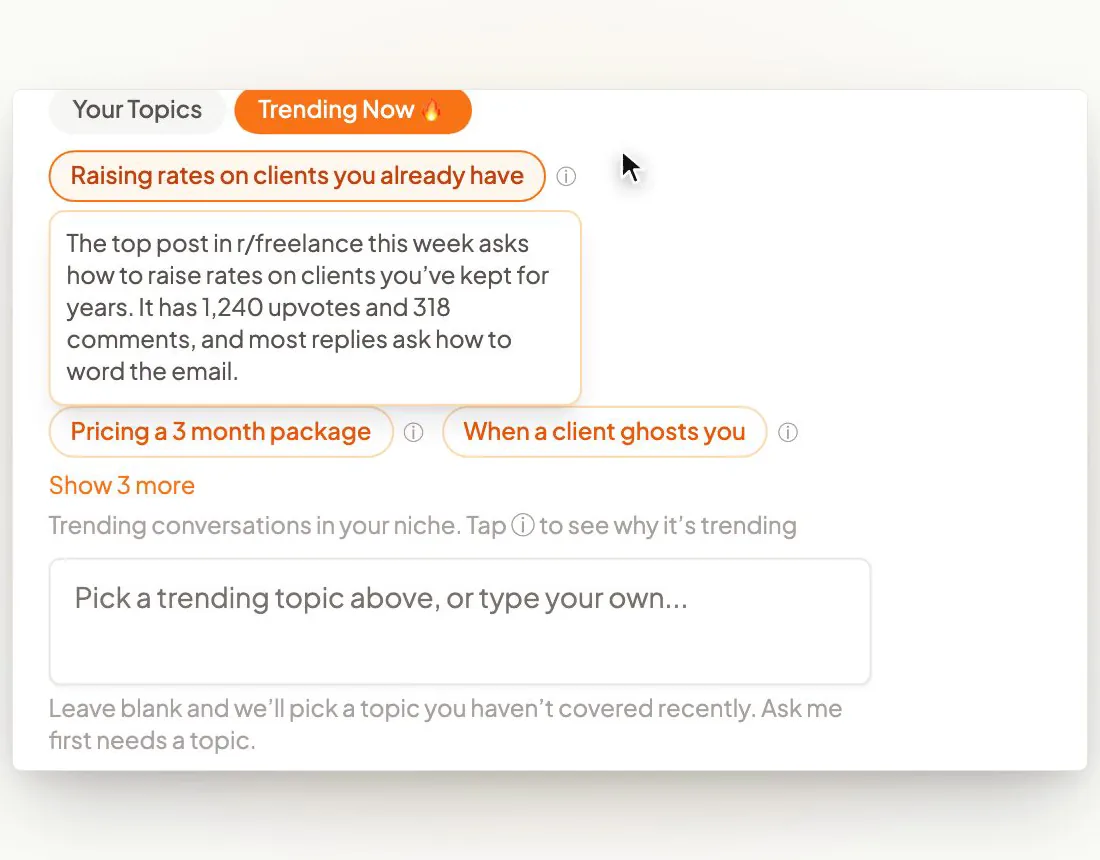
Referrals: give other lawyers something to forward
Plenty of defense lawyers live on referrals, and that's fine until it isn't. "Referrals are a reward for good work. They're not an acquisition strategy," I say in my video on the five client paths. A video gives the referrer something to send.
Two groups of lawyers refer criminal cases. Lawyers in other practice areas get asked "do you know a criminal lawyer?" by divorce, immigration and business clients. Other defense lawyers need a name when they can't take a case. A lawyer who already represents one person in a case usually can't take the co-defendant. Here's a note for the second group.
Subject: If you ever conflict out

Hi [name],

If you can't take a co-defendant, or you get a call
from outside your counties, I'm glad to help.

I take [DUI, drug and assault cases] in [counties],
and families who call me hear back within [time].

This is the video I send families on day one:
[link to your jail-call video]

[Your name], [phone]
For the first group, make referring you a ten-second job. Send this to the family and immigration lawyers you know. They can paste it into a text when a client asks.
[Your name] is a criminal defense lawyer in [county].
This 5-minute video explains the first 48 hours after
an arrest: [link]. [His/her] number is [phone].
Outreach and ads: lawyers only, and only once the content exists
Cold outreach goes to lawyers, never to someone who was just arrested or to their family. Ask a real question first, such as "Do your divorce clients ever get charged mid-case?", and let your videos do the rest when they look you up. Solicitation has its own rule: ABA Model Rule 7.3 covers live person-to-person contact, and your state's version may go further.
Paid search comes last: put money behind a video once it reliably brings calls. Ask "How did you hear about me?" on every first call, and count the answers each Friday. Marketing for lawyers has a Friday sheet to copy, and marketing for personal injury lawyers runs the same system for an injury practice.
One docket-free afternoon records the month
Twelve videos and a Q&A take one afternoon if you choose the questions on a different day. Deciding, saying, recording and editing are separate jobs. Stack them in one seat and a lawyer who's calm in front of a jury freezes in front of a phone. Recording day shouldn't be thinking day explains the split.
Choose the questions with the four kinds of post from my weekly content plan. All four are already in the month above.
- Authority explains a term or corrects a myth, like the bail video or the reaction to the viral rights claim.
- Process walks a family through what comes next, like the first 48 hours or the three questions to ask any lawyer.
- Proof shows your work without a case result. Three kinds need none. One is a pattern you've seen across many cases, with nothing identifying. Another is a public tool walked through on screen, like the county case search. The third is a change in the law, explained for other lawyers.
- Personal is why you do this work. A family wants to know who they're hiring, and this is where they find out.
If your mornings belong to the courthouse, take an afternoon with no docket and use this run sheet.
A docket-free afternoon

1:00  Set up: camera at eye height, mic on, light in front,
      phone face down
1:15  Four long answers, each in sections (about 75 minutes)
2:30  Break, and put on a different shirt
2:45  Eight short videos, back to back (about 45 minutes)
3:30  The Q&A: read the month's family questions and answer
      each one
4:00  Stop. Don't watch anything back today.

Another day (about an hour): trim, add subtitles, write the
four LinkedIn posts, schedule the month.
The shirt is so a month of videos doesn't all look like one Tuesday. As I say in my video on showing your face, "Maybe it took you 3 hours, but you just recorded all of your content for the entire month." Judge the results after three to six months, not three weeks.
What CreateSocial does for a criminal defense practice
CreateSocial helps you build a personal brand that brings in clients, referrals and invitations to speak, without content eating your evenings. It learns what you know from your site, FAQ and past videos. Then it runs the whole content week, video and written: ideas, scripts, posts, recording, editing, thumbnails and scheduling.
- Your charge pages become a month of ideas. Scan your website and add your charge pages, FAQ and blog posts to your knowledge base, plus the handout you give new clients. You get 80 personalized ideas a month from it, each with a hook and talking points or a full script. "Ask me first" asks you a few questions before it writes.
- The next rights myth comes to you. Trending Now brings in what your niche is talking about every Monday. When a "know your rights" video takes off, answer it as a reaction video, in Layout or Stitch.
- The afternoon runs on a teleprompter. Your points sit near the camera, at your desk or in the iPhone app, and each section is its own take with a one-tap retake.
- Fixing a take means deleting words. Cut them from the transcript and they're cut from the video. Eye contact correction keeps your gaze on the viewer while you read. Subtitles in 11 styles are burned in for the parent watching on mute in a courthouse hallway. On the week 4 Q&A, Find Clips suggests the answers that stand alone, and YouTube thumbnails are made from your video and photos of you.
- Referring lawyers get something to read. Turn a video into a LinkedIn post, an email to the lawyers who send you cases, or a LinkedIn carousel with PDF export, like the week 4 checklist. Or write any of them from your knowledge base, no camera needed.
- Then it posts, and you see what worked. Schedule to TikTok, Instagram, YouTube, LinkedIn, Facebook and X with a caption written for each platform, and we post it for you once your accounts are connected. The Analytics page shows followers, views, likes, comments and shares on your connected TikTok, Instagram, YouTube, LinkedIn and Facebook accounts. "Make another like it" turns a post that did well into a new idea on the same topic.
Also in the one plan: Remove Silences, B-roll from free stock video, Dual mode for 16:9 and 9:16 in one take, screen recording with your camera as a bubble, green screen and virtual backgrounds with or without a real green screen, platform safe-zone guides for TikTok, Reels and Shorts, competitor tracking, X threads, blog posts of 1,500 words or more and PNG export for carousels.
I'm Ben Moore, and I built CreateSocial on my own, bootstrapped, here in Cincinnati, Ohio, so you talk to me directly. Feature requests come to me, and a lot of what customers ask for gets built. Before CreateSocial, my agency generated millions of followers and millions of dollars in revenue for its clients, and I've generated hundreds of millions of views.
It costs $129 a month, or $99 a month billed annually, with no add-ons and no per-feature charges. Start your free trial and have the jail-call video recorded by Friday. Want the month mapped to your county first? Book a free strategy call with me.
Your first week: one video and two notes
- Write your profile line, with your practice and your county, and put it on every profile.
- Fill in the jail-call script with your county's facts and your number.
- Record it in six sections, add subtitles, and post it to YouTube, Facebook, Shorts, Reels and TikTok.
- Send the conflict note to three defense lawyers you trust, and the referral text to two family lawyers.
- Ask "How did you hear about me?" on every first call, and count the answers on Friday.
Next week's video is bail and bond. Start a free CreateSocial trial and script, record and schedule both in one place.
Questions people ask
What does marketing do for a criminal defense law firm?
It makes sure the person searching after an arrest, often a parent or partner, finds you and trusts you enough to call. For a small defense practice, that means plain-English videos on what happens next, referrals from other lawyers and a phone that gets answered.
How do criminal defense lawyers get clients?
From other lawyers who refer, from past clients and their families, and from search, often on the day of an arrest. A plain-English video on the first court date helps with all three, because a referrer can forward it and a family can find it.
What should a criminal defense attorney post on social media?
Plain-English answers to what families and defendants ask after an arrest: the jail call, the first court date, bail or bond, how to choose a lawyer and how cases usually end. Keep every post general, with no client details and no promised outcomes.
Should criminal defense lawyers be on TikTok?
Yes, for the person charged, who is often young. In its 2026 survey, Pew Research Center found 65 percent of U.S. adults aged 18 to 29 use TikTok. Post short answers there, and keep the long ones on YouTube and Facebook for parents.
What is the best marketing for a criminal defense lawyer?
The channels you own, content and referrals, because they keep working after you stop paying. Paid search brings calls faster, so put ad money behind the videos that already bring calls rather than in front of them.