

The short answer (updated November 2026):
- Marketing for personal injury lawyers lasts when injured people, and the friend they ask for a name, already know you from your videos. Leads and clicks stop the day you stop paying. A good answer keeps getting found and forwarded.
- Post plain-English answers to what people search after a crash or a fall: the first 48 hours, the insurance call, how a claim works, how your fee works and the myths.
- Lead with YouTube and Facebook, which 84% and 70% of U.S. adults use. Write LinkedIn posts for the lawyers who refer injury cases. Post short answers to Shorts, Reels and TikTok too.
- Send your best video to lawyers in other practice areas and to past clients. Plenty of injured people ask someone for a name first, so give that person a link to forward.
- Record the month in one afternoon. This page has a filled-in month for a solo injury attorney, 10 hooks and a full one-minute script.
You pay for the click, the billboard and the lead list. The day the budget stops, so does the phone. And the people who do call often got your name from someone else.
Marketing for personal injury lawyers works best when injured people, and the people they ask, trust you before the crash. Post short video answers to what people search after an accident, lead with YouTube and Facebook, and give referring lawyers something to forward. Here is what to post and where, a filled-in month, 10 hooks, one full script and the afternoon that records it all.
Paid leads stop when the budget does, so build attention you own
Buying leads rents attention. Content builds attention you keep. Most of the top results for this search are agencies selling ads, leads and websites. Those can work. But each one stops when the spending stops, and the person on the other end has never heard of you.
I put it plainly in my video on the five ways clients find you: "Paid is a volume knob on things that are already working." Turn the knob up on nothing and you pay to stay a stranger.
You aren't trying to reach everyone who might get hurt someday. You want the person in your county who was hurt this week, and the sister or coworker they text for a name. I call this qualified attention. Ten thousand views from three states away bring nobody to your door.
Picture Monday morning after a Saturday crash. Your future client has a sore neck, a claim number and a voicemail from an adjuster. They type their question into YouTube, or they ask the group chat if anyone knows a lawyer. If your video answers the first, and someone in that chat has seen your face, the call comes to you.
In my video on building an audience that buys, I say: "The content doesn't need to perform. It doesn't need tons of views. It needs to exist because the buyer who is 80% of the way there is going to be looking for it." For an injury lawyer, that buyer is in an urgent care waiting room tonight.
Post what injured people search after a crash, in plain English
Post plain-English answers to the questions people ask after a crash or a fall. Five topics cover most of them.
| Topic | Their question, in their words | What your answer covers |
|---|---|---|
| The first 48 hours | "What do I do now?" | Getting checked, writing it down, keeping records, what can wait |
| The insurance call | "Do I have to talk to them?" | Who calls, who they work for, what a recorded statement is |
| How a claim works | "How long will this take?" | The stages in your state, from the crash to the end of the case |
| Your fee | "Can I even afford a lawyer?" | How your fee works, what costs are and when anything is owed |
| Myths | "Is it worth calling at all?" | The wrong ideas you hear on first calls, one per video |
You don't have to guess at these. When we pulled Google's results for this post on November 17, 2026, even searches about marketing an injury practice showed client questions under "People also ask", such as "How much of a $100k settlement will I get?" and "Is it hard to win a personal injury case?" Injured people are searching, and the firms that answer get found.
Keep client details out, promise no outcomes, and run anything about fees, results or testimonials past your state bar's advertising rules. That rules out the usual billboard lines, which is fine. A calm answer to "do I have to talk to the adjuster?" earns more trust than "we fight for you" ever did.
Your FAQ page already lists most of these questions. CreateSocial scans your site so you can add those pages to your knowledge base, then suggests video ideas built on what you've already written. "Ask me first" asks you a few questions before it writes a script, so the answer sounds like what you tell callers on the phone.
Lead with YouTube and Facebook, and write LinkedIn for the lawyers who refer
Put your long answers on YouTube and Facebook, write LinkedIn posts for referring lawyers, and post short answers everywhere else. In Pew Research Center's 2026 survey of 5,511 U.S. adults, 84% use YouTube and 70% use Facebook. A crash can happen to anyone, so start where nearly everyone already is.
YouTube comes first. A four-minute answer to "how does an injury claim work" can keep getting found long after you post it, and it lets someone watch you think before they call. My advice in my video on showing your face is short: "So, double down on YouTube long form." For an injury lawyer, a long video is the consultation before the consultation.
LinkedIn is for referrals, not crash victims. Pew found 51% of college graduates use it, and the ones you want there are other lawyers: the family, criminal defense and estate-planning lawyers whose clients mention a crash at the end of a meeting.
Short video is for reach. Record short answers of their own for Shorts, Reels, TikTok and Facebook, and post every video everywhere. A clip cut from a long answer earns a spot only when it makes sense on its own. If you handle more than injury work, social media for lawyers pairs six practice areas with their platforms.
Then put one line on every profile: who you help, with what, and where. "Injury cases for people hurt in crashes and falls in [city]" beats any slogan.
Ten hooks you can post as written
Each hook names the person, the moment or the place, and none promises a result. Fill the brackets with your city and your state's facts.
The first 48 hours
  "Hurt in a crash in [city] this week? Here's what the next two days should look like."
  "Rear-ended on the way home? Do these three things before bed."

The insurance call
  "The other driver's insurer sent a release to sign. Read this first."
  "Two calls you'll get after a crash, and what each one is for."

How a claim works
  "How long does an injury claim take in [state]? Here are the stages."
  "What a contingency fee is, in 60 seconds."

Myths
  "Myth or fact: if the police report says it was your fault, you have no claim."

For the person they ask
  "Your friend just texted you from the side of the road. Send them this."

Reactions
  "This viral car accident 'hack' gets one thing right and one thing badly wrong."

For referring lawyers (LinkedIn)
  "Family lawyers: when a client mentions a crash in passing, ask this one question."
Notice what's missing. No dollar figures, no "maximum compensation", no "top-rated" and no "expert". An injured person has seen all of that on the billboard by the highway. What they haven't seen is a lawyer calmly explaining the next two days. For more opening lines in other shapes, see these video hook examples.
One full script: the first 48 hours after a crash
Make this video first. It is written to be read off a teleprompter in six short sections, so a stumble costs you one line, not the whole take.
One-minute script: "Hurt in a crash in [city]? The first 48 hours"

Section 1, the hook (5 seconds)
"Hurt in a crash in [city] this week? I'm an injury lawyer,
and here's what the next 48 hours should look like."

Section 2, your health (10 seconds)
"First, get checked by a doctor, even if you feel fine.
Keep every record and receipt from that visit."

Section 3, write it down (15 seconds)
"Tonight, write down what happened while it's fresh:
the time, the place, the weather, what the other driver said.
Keep the photos, their insurance details and any witness
names in one folder."

Section 4, the calls (15 seconds)
"You'll likely hear from the other driver's insurance company.
You can be polite, take the adjuster's name and claim number,
and say you'll call back. [One plain sentence on recorded
statements in [state].]"

Section 5, what can wait (10 seconds)
"Hold off on signing anything from an insurance company,
or posting about the crash, until you've talked to a lawyer,
me or anyone else."

Section 6, the next step (10 seconds)
"I'm [name], an injury lawyer in [city]. This is general
information, not advice about your case. If this is you
or someone you love, call [number]. You'll talk to me."
Two lines carry this script. "Me or anyone else" tells the viewer you aren't pushing. "General information, not advice about your case" keeps it honest. Write the bracketed parts the way you'd say them across the desk, and cut any sentence that needs a footnote. How to write a video script has a longer template for your four-minute YouTube versions.
A month of posts for a hypothetical solo injury attorney
Here is a filled-in month for a solo attorney who handles car crashes and falls in one city. Each week has one long YouTube answer, two short videos and one LinkedIn post. The last column says who each post is for: someone hurt this week, the person they ask, or a lawyer who refers.
| Week | Post | Kind | Format and where | Who it's for |
|---|---|---|---|---|
| 1 | "Hurt in a crash in [city]? The first 48 hours, step by step" | Process | 4-minute video, YouTube and Facebook | Hurt this week |
| 1 | "The adjuster wants a recorded statement. What it is and why they ask" | Authority | 60-second video, Shorts, Reels, TikTok and Facebook | Hurt this week |
| 1 | "Why I do injury work" | Personal | 60-second video, Facebook and Reels | The person they ask |
| 1 | "A published [state] appeals decision on [topic], explained for lawyers outside injury law" | Proof | Written post, LinkedIn | A referring lawyer |
| 2 | "Partly at fault for a crash in [state]? How fault works here" | Authority | 5-minute video, YouTube and Facebook | Hurt this week |
| 2 | "Your friend just texted you from the side of the road. Send them this." | Process | 45-second video, Facebook, Reels and TikTok | The person they ask |
| 2 | "A pattern I see in claims that drag on" | Proof | 60-second video, Shorts and Facebook | Hurt this week |
| 2 | "Why I started my own injury practice" | Personal | Written post, LinkedIn | A referring lawyer |
| 3 | "How my fee works, and what costs are, before you ever call" | Process | 4-minute video, YouTube and Facebook | Hurt this week |
| 3 | "A viral video says never talk to any insurance company. What it gets right and what it leaves out" | Authority | Reaction video, Shorts, Reels and TikTok | Hurt this week |
| 3 | "What I keep in my own glovebox, and why" | Personal | 60-second video, Facebook and Reels | The person they ask |
| 3 | "Three things I check first when a lawyer sends me an injury case" | Proof | Carousel, LinkedIn | A referring lawyer |
| 4 | "How an injury claim works in [state], from the crash to the end of the case" | Process | 6-minute video, YouTube and Facebook | Hurt this week |
| 4 | "Should you post about your accident on social media?" | Authority | 60-second video, Shorts, Reels, TikTok and Facebook | Hurt this week |
| 4 | "A blank [state] crash report form, read line by line" | Proof | 90-second screen recording, YouTube and Facebook | Hurt this week |
| 4 | "Why I answer my own phone" | Personal | Written post, LinkedIn | A referring lawyer |
That's 12 videos from one recording afternoon and four LinkedIn posts with no camera at all. Every week has one post of each kind. Now look at the last column. Seven of the 16 posts are for people who will never hire you themselves but will pass your name on.
The week 3 fee video is decision content: it answers the last question someone has before they call. Pin it beside your first-48-hours video.
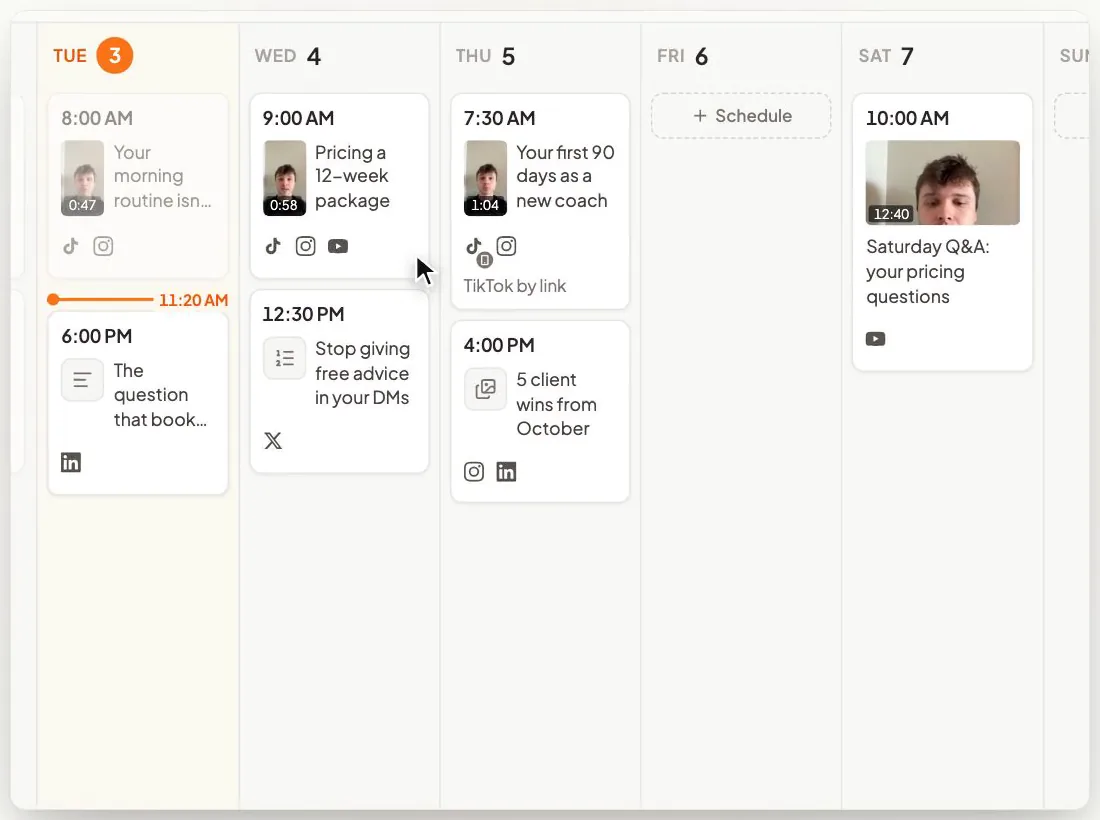
Then schedule the month in one sitting. With CreateSocial, each post gets a caption written for its platform, and we post your videos and LinkedIn posts for you at the times you picked once your accounts are connected. The week 3 carousel comes from the same place, with PDF export.
React to viral legal claims, and let someone else's video start yours
A reaction video gives you a topic and a hook in one. Someone already posted the claim, people are already arguing in the comments, and your job is to explain it properly. I even use a lawyer as the example in my video on reaction content: "A lawyer can respond to a viral claim about the law and explain what someone is getting wrong."
Injury law draws plenty of these, from "never talk to any insurance company" to "partly at fault means no claim". You don't need outrage to answer them. Say what's right, what's missing and how it works in your state.
Before you record, run the test from the same video: "if a client sent me this video, would I actually have something useful to say? If yes, record it. If no, just keep looking." Talk about the claim, never a real person's case. Layout puts you and the clip on screen together, and Stitch plays the clip first, then cuts to you. Reaction videos for coaches walks through both.
Finding the claim is the slow part. Trending Now in CreateSocial brings in what your niche is talking about every Monday, and the studio records the reaction in Layout or Stitch.
How a post becomes a client and a referral
A post turns into a client through one of the five paths a client takes to you, and content runs under every one. A past client or a lawyer in another practice area who refers you gets a link to send, which beats spelling your name out in a text. Warm outreach to past clients, law school friends and your bar section keeps your name ready for the next time someone they know gets hurt. The injured person searches YouTube, Google or ChatGPT the night of the crash and finds your answer, with your name and city on it. Cold outreach goes only to other lawyers, and it opens with a question like "Do your clients ever mention a car accident?" Paid goes behind the one video that already brings calls. That's the volume knob, turned up on something that works.
Two lines stay out of this plan: reaching out to accident victims who haven't contacted you (ABA Model Rule 7.3 bars live person-to-person solicitation, and your state's version may go further), and paying anyone for recommending you (Model Rule 7.2).
Inside those lines, content makes referrals easy to give. Content is the engine under every other client channel makes the full case. Send this to two lawyers in other practice areas this week:
Subject: When your clients mention a car accident

Hi [name],

Your clients probably bring up a crash now and then,
usually at the end of a meeting about something else.

This short video answers what most people want to know
in the first week: [link to your first-48-hours video]

If one of them wants to talk it through, they can call
me directly at [phone].

[Your name], injury lawyer in [city]
Then send past clients a lighter version. It keeps you in mind without asking for anything:
Hi [name], I hope you're feeling better these days.

I made a short video that answers the questions people ask me
in the first week after a crash: [link]

If anyone you know is ever in one, feel free to send it along.
Point every video at a phone number, and answer the same day. On each first call, ask how they found you and write it down. Give it three to six months before you judge it. Marketing for lawyers has a Friday sheet for counting those answers, plus a review request to send when a case closes.
Record the whole month in one afternoon
All 12 videos fit in one afternoon, as long as you pick the questions on a different day. Deciding, saying, recording and editing are four separate jobs. Do them in one seat and a sharp trial lawyer sounds stiff on camera. Recording day shouldn't be thinking day explains why, and a month of content in one afternoon lays out the batch.
Pick the questions by kind. My weekly content plan rotates four kinds of post: authority, proof, process and personal. Authority answers a question better than the comments do, like how fault works in your state. Process walks someone through what happens next. Personal is why you do this work, and it gives the person they ask something to say about you.
Proof is where injury marketing reaches for a verdict number. You don't need one. Proof can be a pattern you see across many claims, with no client details, or a published court decision in plain English. It can be you reading a blank crash report form line by line. A viewer who watches you untangle a confusing form has seen your work, and that persuades a scared person more than a figure on a billboard.
- A few days before (45 minutes). Pick 12 questions, or take the 12 videos in the month above. Write a hook and three talking points for each.
- Set up once (15 minutes). Camera at eye height, mic on, light in front of you, phone on do not disturb.
- Record (about 2 hours). All 12 answers back to back, each in sections. Don't watch them back yet.
- Another day (about an hour). Trim, add subtitles, make thumbnails, write the LinkedIn posts and schedule the month.
This is the afternoon CreateSocial's studio is built for. Your talking points sit on a teleprompter near the camera, each section is its own take with a one-tap retake, and Dual mode frames 16:9 for YouTube and 9:16 for Shorts in the same take. The first month is the thinnest your library will ever be.
How CreateSocial runs an injury practice's content month
CreateSocial helps injury lawyers build a name that brings in clients, referrals and speaking invitations, without content eating the hours you spend on cases. It learns what you know from your site and your past videos, then runs the whole content week, video and written: ideas, scripts, posts, recording, editing, thumbnails and scheduling. Here is the month above, inside it.
- The questions are waiting before the afternoon. Scan your website and add your practice pages, FAQ and blog to your knowledge base, plus past videos and the handouts you give new clients. You get 80 personalized ideas a month from them, each with a hook and talking points or a full script. Trending Now adds what your niche is talking about every Monday, which is where the next viral claim shows up.
- Twelve videos take one sitting. Read from the teleprompter near your camera, at your desk or in the iPhone app, and record in sections with one-tap retakes. Answer that viral video with a reaction, in Layout or Stitch.
- The edit is mostly deleting words. Delete them from the transcript and they're cut from the video. Remove Silences takes out the pauses in one click, eye contact correction keeps your gaze on the viewer, and subtitles in 11 styles are drawn in for anyone watching with the sound off in a waiting room.
- Long answers keep working. Make YouTube thumbnails from the video and photos of you, in your brand style. On a long Q&A video or a recorded webinar, Find Clips suggests the moments that stand alone, and each one you pick becomes its own vertical clip with subtitles.
- Every video feeds your referrers. Turn any answer into a LinkedIn post, an email to past clients and referring lawyers, or a LinkedIn carousel with PDF export, like the week 3 carousel. Or write them from your knowledge base with no video at all.
- It goes out on its own, and gets counted. Schedule to TikTok, Instagram, YouTube, LinkedIn, Facebook and X, each with a caption written for that platform, and we post it for you once your accounts are connected. The Analytics page tracks followers, views, likes, comments and shares on your connected TikTok, Instagram, YouTube, LinkedIn and Facebook accounts, so your count of how callers found you gets a second column.
Also in the one plan: competitor tracking, X threads and blog posts of 1,500 words or more, PNG export for carousels, Dual mode for 16:9 and 9:16 in one take, screen recording with your camera as a bubble for walking through a blank crash report form, green screen and virtual backgrounds with or without a real green screen, platform safe-zone guides for TikTok, Reels and Shorts, and B-roll from free stock video.
An injured client wants to reach the lawyer from the video. You get the same deal here. I'm Ben Moore, and I built CreateSocial on my own, bootstrapped, here in Cincinnati, Ohio, so you talk to me directly. Feature requests come to me, and a lot of what customers ask for gets built. Before CreateSocial, my agency generated millions of followers and millions of dollars in revenue for its clients, and I've generated hundreds of millions of views.
It costs $129 a month, or $99 a month billed annually, with no add-ons and no per-feature charges. Start your free trial and record your first-48-hours video this week. Want the month built around your own practice first? Book a free strategy call with me.
Record your first-48-hours video this week
- Fill in the script above with your city, your number and one plain sentence on recorded statements in your state.
- Record it in six sections, add subtitles, and post it to YouTube, Facebook, Shorts, Reels and TikTok.
- Send it to two lawyers in other practice areas with the note above, and to five past clients with the shorter one.
- Write down how every new caller found you this month.
Next week, film how your fee works. A free CreateSocial trial gives you the ideas, the teleprompter and the schedule for both.
Questions people ask
What does marketing do in a law firm?
It helps the right people find you, trust you and call. For a personal injury practice, that means being the lawyer an injured person, or the friend they ask for a name, already knows from your videos, your reviews and the lawyers who refer to you.
How do personal injury lawyers get clients?
Through referrals from past clients and other lawyers, through search and through paid ads. Content feeds all three, because a video that answers what to do after a crash is something a referrer can forward and a search engine can find.
How do I get personal injury clients without buying leads?
Build the two channels you own, referrals and content. Record a month of short video answers to what injured people search, send the best one to lawyers in other practice areas and to past clients, and put ad money only behind videos that already bring calls.
What should a personal injury lawyer post on social media?
Plain-English answers to what injured people ask, such as what to do in the first 48 hours, how a claim works, how your fee works and the myths you correct every week. Add reactions to viral legal claims, and LinkedIn posts for the lawyers who refer injury cases.
What are some catchy slogans for law firms?
Skip the slogan and write one plain line instead: who you help, with what, and where, such as injury cases for people hurt in crashes and falls in your city. It tells the right viewer they found the right lawyer, and it promises no outcome.